The Next Generation of Financial Software Has Arrived
Banks, fintech companies, payment processors, and digital asset platforms are rapidly adopting AI agents to automate customer service, fraud investigations, payment operations, compliance workflows, and software development.
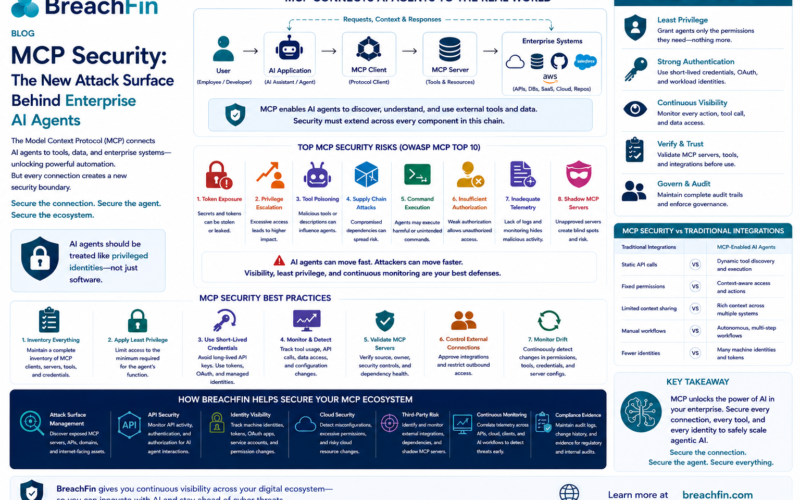
Unlike traditional chatbots, AI agents can make decisions, call APIs, access databases, execute workflows, and interact with multiple systems without constant human supervision.
This new level of automation promises tremendous efficiency—but it also introduces an entirely new attack surface.
As organizations deploy autonomous AI into production, the question is no longer “Can AI improve operations?”
The question is:
“Who is monitoring the AI?”
AI Agents Have Privileged Access
Modern AI agents may have access to:
- Payment APIs
- Customer information
- Internal knowledge bases
- CRM systems
- Cloud infrastructure
- Source code repositories
- Financial records
- Administrative workflows
If compromised or manipulated, an AI agent can unintentionally perform actions that impact security, compliance, or customer trust.
The more capable an AI becomes, the more important continuous monitoring becomes.
Emerging Risks Organizations Must Address
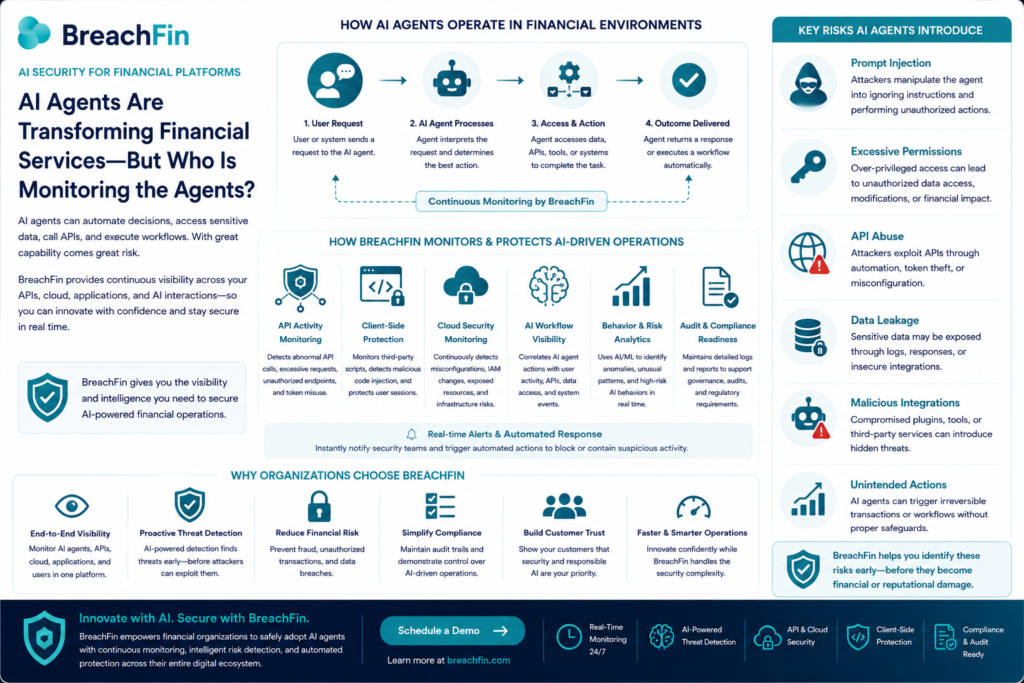
Prompt Injection
Attackers can craft malicious prompts that manipulate an AI agent into ignoring its original instructions.
Examples include:
- Revealing confidential information
- Executing unintended workflows
- Accessing restricted data
- Calling unauthorized APIs
Prompt injection is becoming one of the most discussed AI security threats.
Excessive Permissions
Many AI agents are granted broad access during development.
Without proper governance, an AI agent may have permission to:
- Modify customer records
- Execute cloud operations
- Access production databases
- Initiate financial workflows
Applying the principle of least privilege is just as important for AI as it is for human users.
API Abuse
AI agents frequently interact with APIs.
Without monitoring, attackers may exploit:
- Excessive API requests
- Unauthorized API calls
- Misconfigured permissions
- Exposed API tokens
Continuous API monitoring helps identify unusual behavior before it impacts production systems.
Data Leakage
AI agents often process sensitive information.
Without appropriate safeguards, confidential data could be unintentionally exposed through:
- Generated responses
- Logging systems
- External integrations
- Misconfigured plugins
Organizations should classify sensitive data and control what AI systems can access.
Why Traditional Security Is Not Enough
Existing security tools monitor:
- Servers
- Networks
- Endpoints
- Firewalls
AI introduces a different challenge.
Organizations must now monitor:
- AI decisions
- Prompt behavior
- API usage
- Model interactions
- Workflow execution
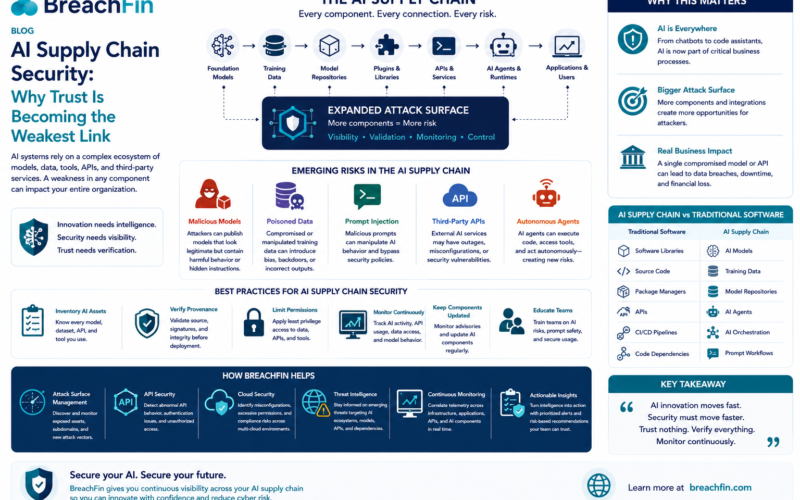
- Third-party AI plugins
Security visibility must extend beyond infrastructure into intelligent systems.
How BreachFin Helps Secure AI-Driven Financial Platforms
BreachFin provides continuous visibility across modern financial applications, helping organizations identify emerging threats before they impact customers or operations.
Continuous API Monitoring
Detect:
- Abnormal API usage
- Unauthorized endpoints
- Token misuse
- Suspicious request patterns
Client-Side Protection
Identify:
- Malicious JavaScript
- Third-party script compromises
- Browser manipulation
- Supply chain attacks
Cloud Security Monitoring
Continuously monitor:
- IAM permission changes
- Cloud misconfigurations
- Infrastructure drift
- Exposed storage
- Configuration risks
AI Workflow Visibility
Correlate AI interactions with:
- User activity
- API calls
- Cloud events
- Authentication logs
- Behavioral anomalies
This helps organizations understand how AI agents interact with production environments.
Risk Analytics
BreachFin correlates multiple security signals into actionable intelligence by analyzing:
- Authentication activity
- API behavior
- Infrastructure events
- Client-side changes
- User behavior
- Cloud security posture
Security teams gain a centralized view of emerging risks.
Building Trust in AI
Organizations deploying AI should implement:
- Continuous monitoring
- Strong identity verification
- Least-privilege access
- API security
- Audit logging
- Human approval for high-risk actions
- Secure AI governance
AI should accelerate business—not increase operational risk.
Final Thoughts
AI agents are reshaping financial services by automating complex workflows and improving operational efficiency. However, with greater autonomy comes greater responsibility. Organizations must ensure these systems are continuously monitored, governed, and secured against emerging threats.
BreachFin helps organizations build trust in AI by providing continuous visibility across APIs, cloud infrastructure, client-side applications, and security events. As AI adoption accelerates, proactive monitoring will become essential for protecting sensitive financial data, maintaining compliance, and ensuring resilient digital operations.