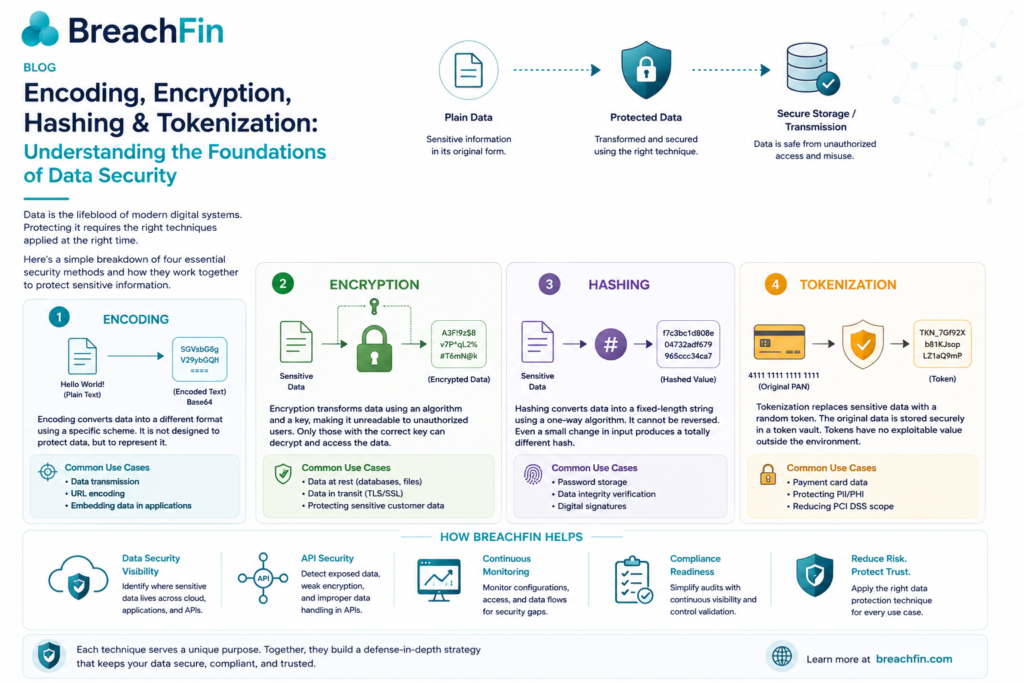
Not All Data Protection Techniques Are the Same
In cybersecurity, terms like encoding, encryption, hashing, and tokenization are often used interchangeably.
While they all transform data in some way, they serve completely different purposes.
Using the wrong technique can expose sensitive information, create compliance challenges, or leave applications vulnerable to attack.
For organizations handling payment card data, personally identifiable information (PII), healthcare records, or financial transactions, understanding these differences is essential.
Let’s explore what each technique does, where it should be used, and how organizations can build a layered data protection strategy.
Why Data Protection Matters
Every organization stores and processes sensitive information.
Examples include:
- Credit card numbers
- Customer passwords
- Bank account information
- Social Security Numbers
- API keys
- Healthcare records
- Digital wallets
- Authentication tokens
Protecting this information requires choosing the appropriate security technique for each use case.
What Is Encoding?
Encoding converts data into another format so it can be safely transmitted or stored.
Unlike encryption, encoding is not designed to provide security.
Anyone who understands the encoding format can decode the original data.
Common Examples
- Base64
- URL Encoding
- HTML Encoding
- ASCII
- UTF-8
Typical Use Cases
- Email attachments
- Web requests
- Data serialization
- Character conversion
Example
Original Text
Hello WorldBase64 Encoded
SGVsbG8gV29ybGQ=Anyone can decode it back into the original text.
Encoding improves compatibility—not confidentiality.
What Is Encryption?
Encryption protects data by converting readable information into ciphertext using a cryptographic algorithm and a secret key.
Only someone possessing the correct key can decrypt the information.
Encryption protects data against unauthorized access.
Common Algorithms
- AES-256
- RSA
- ECC
- ChaCha20
- TLS
Typical Use Cases
- Databases
- File storage
- HTTPS
- VPNs
- Cloud storage
- Email encryption
Example
Original
4111111111111111Encrypted
8Fa92Ls#GxP19KeA...Without the key, recovering the original data should be computationally infeasible.
What Is Hashing?
Hashing converts data into a fixed-length value called a hash.
Unlike encryption:
Hashes cannot be reversed.
The purpose is verification—not secrecy.
Even changing a single character completely changes the resulting hash.
Common Algorithms
- SHA-256
- SHA-384
- SHA-512
- Bcrypt
- Argon2
- PBKDF2
Typical Use Cases
- Password storage
- Digital signatures
- File integrity
- Software verification
Example
Password
Password123SHA-256 Hash
ef92b778bafe771e89245...Applications compare hashes instead of storing actual passwords.
What Is Tokenization?
Tokenization replaces sensitive data with a randomly generated value called a token.
The token has no mathematical relationship to the original data.
The original value is stored securely inside a protected token vault.
Example
Original Card Number
4111111111111111Token
TKN_7Gf92Xb81KJ...If attackers steal the token, it has little or no value outside the tokenization system.
Common Use Cases
- Payment processing
- PCI DSS compliance
- PII protection
- Healthcare systems
- Customer identifiers
Comparing the Four Techniques
| Technique | Reversible | Purpose | Common Use |
|---|---|---|---|
| Encoding | ✅ Yes | Data formatting | Base64, URLs, email |
| Encryption | ✅ Yes (with key) | Confidentiality | Files, databases, HTTPS |
| Hashing | ❌ No | Integrity and verification | Passwords, digital signatures |
| Tokenization | Depends on secure token vault | Protect sensitive data | Payment cards, PII, PHI |
Each technique addresses a different security requirement.
Which One Should You Use?
Use Encoding When
- Systems require compatible formats
- Sending binary data over text protocols
- Representing special characters
Encoding should never be used to protect sensitive information.
Use Encryption When
You need confidentiality.
Examples include:
- Customer databases
- Financial transactions
- Cloud storage
- API communication
- Backup files
Use Hashing When
You need to verify information without revealing it.
Examples include:
- Password verification
- Digital signatures
- File integrity checks
- Certificate validation
Use Tokenization When
You need to reduce exposure to sensitive regulated information.
Ideal for:
- Payment card data
- Personally Identifiable Information (PII)
- Protected Health Information (PHI)
- Customer identifiers
Tokenization can also help reduce the amount of sensitive data directly handled by applications, simplifying certain compliance efforts.
How BreachFin Helps Protect Sensitive Data
Protecting data requires more than choosing the right cryptographic technique.
Organizations also need visibility into where sensitive information exists and how it is used.
BreachFin helps organizations strengthen their security posture through continuous monitoring and proactive risk detection.
API Security
Sensitive information frequently moves through APIs.
BreachFin continuously monitors:
- Unencrypted API traffic
- Authentication anomalies
- Exposed sensitive fields
- Token misuse
- API abuse
Helping organizations identify risks before attackers exploit them.
Cloud Security Visibility
Cloud environments often contain sensitive data stores.
BreachFin identifies:
- Misconfigured storage
- Excessive IAM permissions
- Public cloud exposure
- Configuration drift
Reducing opportunities for data exposure.
Client-Side Security
Sensitive information can also be exposed within browsers.
BreachFin continuously monitors:
- Third-party JavaScript
- Form tampering
- Browser-based attacks
- Unauthorized data collection
- Supply chain risks
Protecting customer interactions before data leaves the browser.
Continuous Compliance Monitoring
Organizations handling payment and regulated data must demonstrate ongoing security.
BreachFin helps security teams maintain visibility into:
- Data protection controls
- API security
- Infrastructure changes
- Security events
- Audit evidence
Supporting stronger operational security and compliance readiness.
Building a Layered Data Protection Strategy
No single technology protects every type of data.
Modern organizations often use all four techniques together:
- Encoding ensures compatibility between systems.
- Encryption protects data confidentiality.
- Hashing verifies integrity and securely stores passwords.
- Tokenization minimizes exposure of highly sensitive information.
When combined with continuous monitoring, identity management, secure software development, and strong governance, these technologies form the foundation of a modern data security strategy.
Final Thoughts
Understanding the differences between encoding, encryption, hashing, and tokenization is fundamental to designing secure applications and protecting sensitive information.
Choosing the wrong technique can introduce unnecessary risk, while applying the right one at the right stage strengthens security, improves compliance, and builds customer trust.
At BreachFin, we believe effective data protection extends beyond cryptography. By combining continuous monitoring across APIs, cloud infrastructure, client-side applications, authentication systems, and sensitive data flows, organizations gain the visibility needed to identify risks early and protect what matters most.