Your Business Runs on APIs. So Do Modern Cyberattacks.
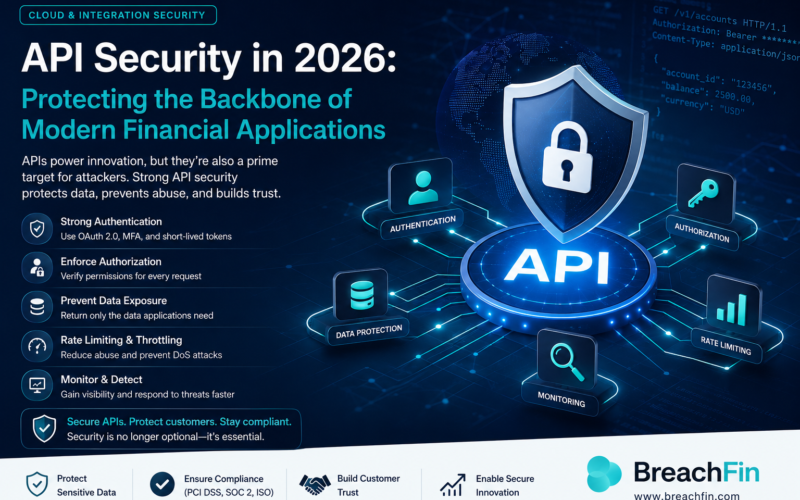
Every financial transaction, mobile banking request, crypto transfer, payment authorization, and Open Banking integration depends on APIs.
APIs have become the backbone of digital finance.
Unfortunately, they have also become one of the most attractive attack surfaces for cybercriminals.
While organizations invest heavily in protecting networks, endpoints, and cloud infrastructure, APIs often remain under-monitored despite exposing critical business functions directly to the internet.
For banks, fintech companies, payment processors, and digital asset platforms, API security is no longer just an IT concern—it is a business requirement.
The Modern API Landscape
A single customer transaction may involve dozens of API calls between:
- Mobile applications
- Authentication providers
- Payment gateways
- Fraud detection systems
- Customer databases
- Cloud services
- Third-party fintech platforms
- Digital wallets
Every API expands the organization’s attack surface.
The more APIs deployed, the greater the need for continuous visibility.
Why Attackers Target APIs
Unlike traditional web applications, APIs expose business logic directly.
Attackers frequently target APIs because they can provide access to:
- Customer accounts
- Payment systems
- Financial records
- Authentication tokens
- Internal services
- Administrative functions
Instead of attacking infrastructure, attackers increasingly exploit application interfaces.
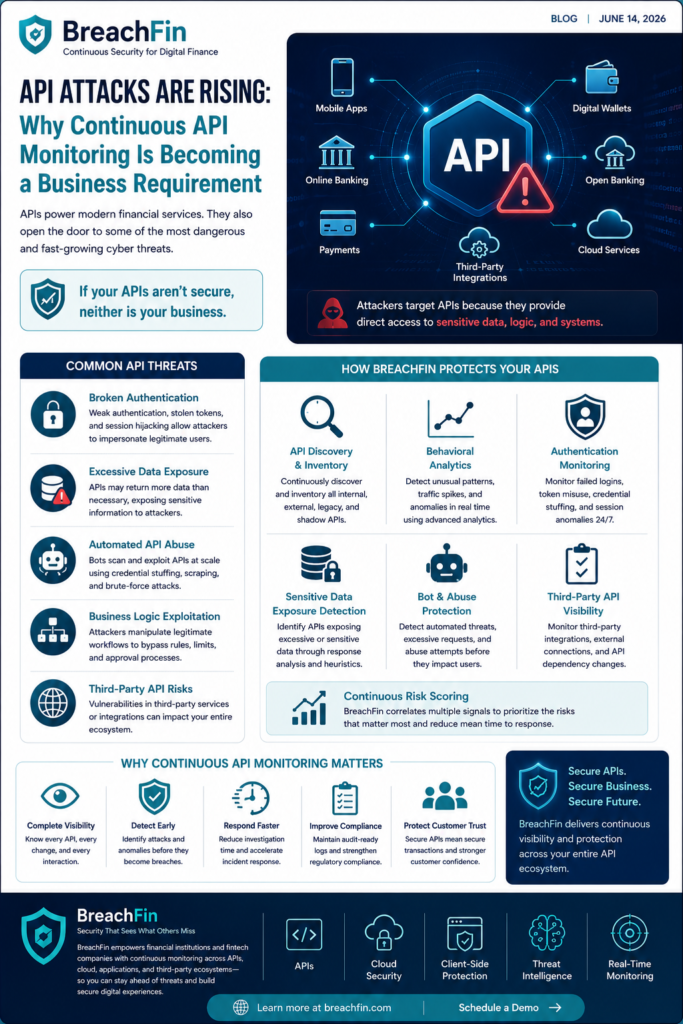
Common API Threats
Broken Authentication
Weak authentication allows attackers to impersonate legitimate users through stolen credentials, exposed tokens, or session hijacking.
Excessive Data Exposure
Some APIs return sensitive information that applications never actually use.
Without proper controls, attackers may retrieve:
- Personally identifiable information
- Account details
- Payment information
- Internal identifiers
Automated API Abuse
Bots continuously scan APIs searching for:
- Weak authentication
- Exposed endpoints
- Rate limit weaknesses
- Credential stuffing opportunities
Automation enables attackers to launch thousands of requests within minutes.
Business Logic Exploitation
Not every API attack exploits software vulnerabilities.
Some attacks abuse legitimate workflows such as:
- Bypassing payment limits
- Replaying transactions
- Manipulating approval processes
- Exploiting pricing logic
These attacks often bypass traditional security controls.
Traditional Security Has Limited Visibility
Firewalls, WAFs, and endpoint protection remain important.
However, they often cannot answer critical questions such as:
- Which APIs are publicly exposed?
- Which APIs are no longer being used?
- Which third-party APIs are communicating with production systems?
- Has an endpoint suddenly started returning more sensitive information?
- Is unusual API behavior occurring right now?
Without continuous monitoring, these risks may remain undetected.
How BreachFin Helps Protect Modern APIs
BreachFin provides continuous visibility across your API ecosystem so organizations can identify emerging risks before attackers exploit them.
API Discovery
BreachFin continuously identifies:
- Internal APIs
- External APIs
- Legacy APIs
- Third-party integrations
- Shadow APIs
Organizations gain complete visibility into their API inventory.
Behavioral Analytics
Instead of relying only on known attack signatures, BreachFin continuously analyzes API behavior to detect:
- Unusual request volumes
- Geographic anomalies
- Authentication irregularities
- Suspicious client behavior
- Unexpected traffic patterns
Behavioral monitoring helps identify attacks that traditional tools may overlook.
Authentication Monitoring
BreachFin continuously monitors:
- Failed authentication attempts
- Token misuse
- Credential stuffing
- Session anomalies
- Privilege escalation attempts
Early detection helps prevent account compromise.
Sensitive Data Exposure Detection
BreachFin helps identify APIs that expose more information than intended by monitoring:
- Response changes
- Sensitive data leakage
- Misconfigured endpoints
- Excessive data exposure
Reducing unnecessary data exposure minimizes business risk.
Third-Party API Visibility
Modern applications depend on numerous external providers.
BreachFin provides visibility into:
- Third-party API usage
- New external integrations
- Unexpected outbound connections
- API dependency changes
Organizations can better understand how external services affect their security posture.
Continuous Risk Scoring
Rather than generating isolated alerts, BreachFin correlates multiple security signals to prioritize the risks that matter most.
Risk scoring may incorporate:
- Authentication behavior
- API activity
- Cloud events
- Client-side indicators
- User behavior
- Infrastructure changes
This enables security teams to focus on high-risk events first.
Why Continuous Monitoring Matters
API environments evolve constantly.
Developers release new endpoints.
Partners introduce new integrations.
Cloud infrastructure changes.
Attackers adapt.
Security performed once every few months cannot keep pace with this rate of change.
Continuous monitoring helps organizations:
- Detect emerging threats earlier
- Reduce incident response time
- Improve API governance
- Strengthen compliance
- Protect customer trust
The BreachFin Advantage
BreachFin provides organizations with continuous visibility across:
- APIs
- Cloud infrastructure
- Client-side applications
- Authentication systems
- Third-party dependencies
- Security events
Instead of reacting after an incident, organizations can identify suspicious behavior while attacks are still developing.
Final Thoughts
As digital financial services continue expanding, APIs have become one of the most valuable—and most targeted—components of modern infrastructure. Protecting them requires more than traditional perimeter defenses.
Continuous API monitoring provides the visibility needed to identify hidden risks, detect abnormal behavior, and respond before attackers can exploit vulnerabilities.
At BreachFin, we believe API security should be continuous, intelligent, and proactive—because every secure transaction begins with a secure API.