APIs Power Modern Business
Every mobile banking app, payment gateway, fintech platform, and cloud service depends on APIs. They allow applications to communicate, exchange data, and automate transactions in real time.
While APIs accelerate innovation, they have also become one of the most targeted attack surfaces. According to industry research, APIs now account for a significant portion of internet traffic, making them attractive targets for attackers seeking sensitive customer data, authentication tokens, and financial information.
As organizations continue expanding their digital services, API security has become a business requirement—not just a developer concern.
Why APIs Are Attractive Targets
Unlike traditional web applications, APIs often expose direct access to backend services and business logic. If they are not properly secured, attackers can exploit them to retrieve confidential data, manipulate transactions, or disrupt operations.
Common reasons APIs become vulnerable include:
- Weak authentication
- Excessive data exposure
- Broken authorization
- Insecure API keys
- Lack of rate limiting
- Poor input validation
- Misconfigured CORS policies
A single vulnerable API can expose millions of customer records.
The Most Common API Security Risks
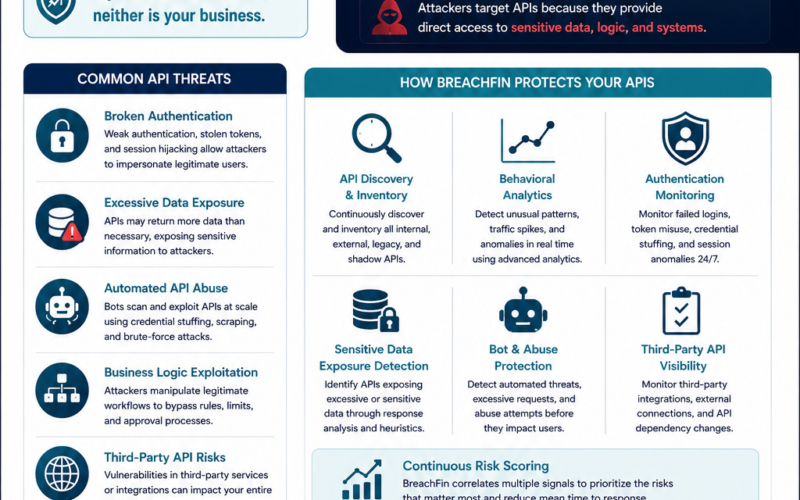
Broken Authentication
Poor authentication mechanisms allow attackers to impersonate legitimate users.
Examples include:
- Weak passwords
- Long-lived access tokens
- Missing MFA
- Hardcoded credentials
Strong identity verification should always be the first layer of defense.
Broken Authorization
Authentication confirms who a user is.
Authorization determines what they are allowed to access.
Many breaches occur because APIs verify identity but fail to validate whether users are authorized to access specific resources.
Excessive Data Exposure
Some APIs return more information than applications actually require.
For example, an application displaying a user’s name may unintentionally return:
- Email address
- Phone number
- Internal account IDs
- Payment information
- Administrative flags
Developers should only expose the minimum data necessary.
Injection Attacks
Improper input validation can allow attackers to inject malicious commands into backend systems.
Common examples include:
- SQL Injection
- NoSQL Injection
- Command Injection
All user input should be validated and sanitized before processing.
Lack of Rate Limiting
Without request limits, attackers can perform:
- Credential stuffing
- Password guessing
- API scraping
- Denial-of-Service attacks
Rate limiting helps protect services from abuse while maintaining availability for legitimate users.
API Security Best Practices
Organizations should adopt a layered security approach.
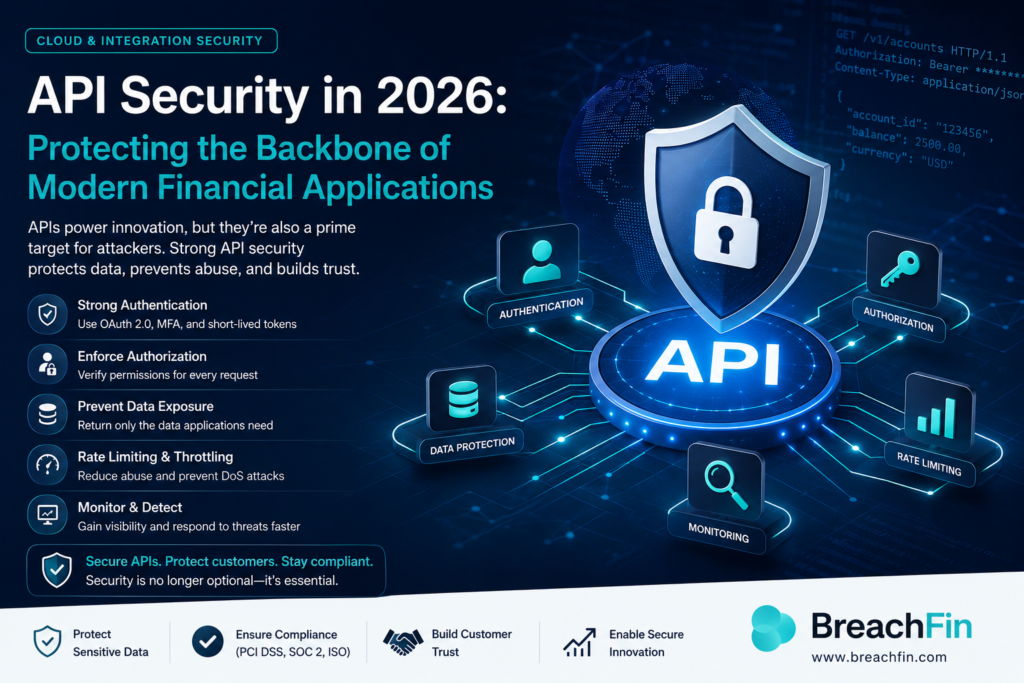
Use Strong Authentication
Implement:
- OAuth 2.0
- OpenID Connect
- Multi-factor authentication
- Short-lived access tokens
Avoid sharing permanent API keys whenever possible.
Enforce Least Privilege
Applications should only receive the permissions they need.
Limit API scopes and regularly review access permissions.
Encrypt Data
Use TLS for all API communications.
Sensitive information should also be encrypted while stored.
Validate Every Request
Never trust client input.
Validate:
- Parameters
- Headers
- Content types
- File uploads
- Request sizes
Input validation significantly reduces attack opportunities.
Monitor API Activity
Continuous monitoring helps detect:
- Abnormal request volumes
- Failed authentication attempts
- Geographic anomalies
- Unexpected endpoint usage
- Privilege escalation attempts
Visibility enables faster incident response.
Maintain an API Inventory
Many organizations struggle with “shadow APIs”—undocumented endpoints that remain publicly accessible after development.
Maintain an up-to-date inventory of:
- Public APIs
- Internal APIs
- Third-party integrations
- Deprecated endpoints
You cannot secure what you do not know exists.
API Security in Financial Services
Banks, payment processors, fintech companies, and digital asset platforms rely heavily on APIs for:
- Payment processing
- Account management
- Identity verification
- Fraud detection
- Open Banking
- Real-time transfers
- Cryptocurrency transactions
Because these APIs handle highly sensitive financial data, even minor security weaknesses can have significant business and regulatory consequences.
Strong API governance should be integrated into every stage of the software development lifecycle.
Building API Security into Your Development Process
Security should not be an afterthought.
Organizations should:
- Perform API security testing during development
- Scan for vulnerabilities continuously
- Review authentication and authorization logic
- Monitor production traffic
- Test third-party integrations
- Maintain secure coding standards
Embedding security early reduces risk and lowers remediation costs.
Final Thoughts
APIs have become the foundation of modern digital services, especially within financial institutions and cloud-native applications. As organizations expose more functionality through APIs, attackers continue to evolve their techniques to exploit weak authentication, authorization flaws, and insecure integrations.
A strong API security strategy combines secure development practices, continuous monitoring, robust authentication, least-privilege access controls, and regular security assessments. Organizations that treat APIs as critical assets—not just software interfaces—are better positioned to protect customer data, maintain compliance, and build lasting trust.