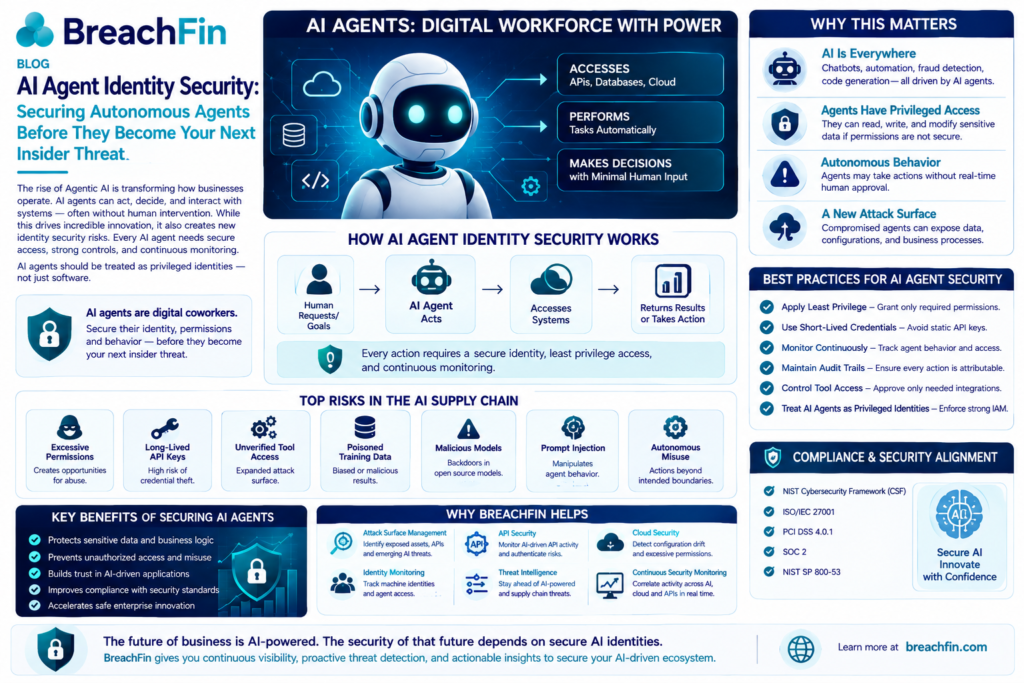
The rise of Agentic AI is transforming how businesses operate. Unlike traditional AI assistants that simply respond to prompts, AI agents can execute tasks, interact with APIs, query databases, access cloud resources, and make decisions with minimal human intervention.
Organizations are already deploying AI agents to:
- Automate customer support
- Review financial transactions
- Analyze cybersecurity alerts
- Generate software code
- Manage cloud infrastructure
- Process compliance documentation
While these capabilities improve productivity, they introduce a new cybersecurity challenge:
How do you secure an identity that never sleeps, never forgets, and can interact with hundreds of systems every minute?
AI agents should be treated like privileged users—not just software.
The Rise of Machine Identities
For years, organizations focused on securing human identities.
Today, machine identities already outnumber human users by a significant margin.
Examples include:
- Service accounts
- API keys
- OAuth applications
- Workload identities
- Kubernetes service accounts
- Cloud roles
- AI agents
Every AI agent receives permissions that determine what it can access.
If compromised or overprivileged, an AI agent could unintentionally expose sensitive information or execute harmful actions at machine speed.
Why AI Agents Require Identity Governance
Unlike traditional applications, AI agents continuously make decisions.
An AI agent may:
- Read customer records
- Access payment APIs
- Query internal databases
- Create cloud resources
- Execute automation workflows
- Modify security configurations
Without strong identity controls, organizations may lose visibility into:
- What the agent accessed
- Why it accessed the data
- Whether the request was authorized
- Whether permissions exceeded business requirements
Common Risks
Excessive Permissions
Many AI agents are granted broad administrative access for convenience.
This violates the Principle of Least Privilege.
An AI assistant used for reporting does not require administrator permissions to cloud infrastructure.
Long-Lived API Keys
Many AI applications rely on:
- API tokens
- Service accounts
- OAuth credentials
- Cloud access keys
If these credentials are exposed, attackers may gain access without compromising a human account.
Organizations should prefer short-lived credentials wherever possible.
Unverified Tool Access
Modern AI agents frequently connect to:
- GitHub
- Slack
- Salesforce
- AWS
- Google Workspace
- Microsoft 365
- Payment APIs
Every connected tool expands the AI agent’s attack surface.
Organizations should approve only necessary integrations.
Autonomous Decision Making
AI agents increasingly perform actions without waiting for human approval.
Poorly designed workflows may allow an agent to:
- Delete cloud resources
- Modify IAM policies
- Send confidential information
- Approve transactions
- Execute unintended automation
Human oversight remains essential for high-risk operations.
Identity Security Best Practices
Treat AI Agents as Privileged Identities
Apply the same controls used for administrators:
- Multi-layer authorization
- Continuous monitoring
- Audit logging
- Approval workflows
Apply Least Privilege
Grant AI agents only the permissions required for their specific function.
Review permissions regularly as responsibilities change.
Use Short-Lived Credentials
Avoid static API keys where possible.
Adopt:
- OAuth 2.0
- Workload Identity Federation
- Temporary cloud credentials
- Managed identities
This reduces the impact of credential theft.
Monitor Agent Activity
Organizations should continuously monitor:
- API requests
- Authentication events
- Tool usage
- Sensitive data access
- Cloud resource changes
- Configuration updates
Visibility helps detect abnormal behavior early.
Maintain Complete Audit Trails
Every AI action should be attributable.
Security teams should know:
- Which agent acted
- Which identity was used
- Which resource was accessed
- What action occurred
- When it happened
Auditability supports both investigations and compliance.
AI Identity Security and Compliance
Identity governance aligns with leading cybersecurity frameworks, including:
- NIST Cybersecurity Framework (CSF)
- NIST SP 800-53
- ISO/IEC 27001
- PCI DSS 4.0.1
- SOC 2
- CIS Controls
As organizations deploy more AI agents, identity governance will become a key part of demonstrating effective security controls.
How BreachFin Helps
AI agents interact with APIs, cloud services, authentication systems, and third-party platforms. BreachFin provides continuous visibility across these environments to help organizations strengthen AI security.
API Security
Monitor AI-driven API activity to identify:
- Abnormal authentication
- Token misuse
- Excessive requests
- Unauthorized actions
Cloud Security
Continuously detect:
- Excessive IAM permissions
- Configuration drift
- Public cloud exposure
- Privilege escalation
Identity Monitoring
Gain visibility into:
- Service accounts
- Machine identities
- Authentication events
- Permission changes
- Access anomalies
Continuous Threat Monitoring
Correlate activity across:
- APIs
- Cloud infrastructure
- Client-side applications
- Authentication systems
- AI-enabled workflows
to identify emerging threats before they become incidents.
Compliance Readiness
Maintain continuous evidence supporting regulatory frameworks through ongoing monitoring, logging, and security validation.
Preparing for the Agentic AI Era
AI agents are rapidly becoming digital coworkers with access to sensitive systems and business processes. Organizations that govern these identities as carefully as they govern human users will be better prepared to reduce cyber risk while enabling innovation.
Identity should remain at the center of every AI security strategy.
Conclusion
The future of enterprise AI depends not only on smarter models but also on stronger identity controls. Every AI agent represents a new digital identity that must be authenticated, authorized, monitored, and governed throughout its lifecycle.
Organizations that adopt least-privilege access, continuous monitoring, and comprehensive audit trails will be better positioned to safely scale AI across their operations.
At BreachFin, we help organizations secure modern digital ecosystems through continuous monitoring of APIs, cloud infrastructure, client-side applications, authentication systems, machine identities, and third-party integrations. As AI adoption accelerates, our mission is to provide the visibility and intelligence needed to protect both human and machine identities.