Cybercriminals are constantly finding new ways to exploit trust on the internet. For years, organizations have defended against typosquatting, combosquatting, and domain impersonation. However, the rise of generative AI has introduced an entirely new category of domain-based attacks: Phantom Squatting and Hallucination Squatting.
Unlike traditional domain abuse, these attacks don’t rely on misspelled versions of existing websites. Instead, they exploit future possibilities and AI-generated misinformation, allowing attackers to register domains that appear legitimate before businesses—or even customers—know they exist.
As AI becomes a primary source of information for users, these attacks present a growing challenge for organizations seeking to protect their brand, customers, and digital reputation.
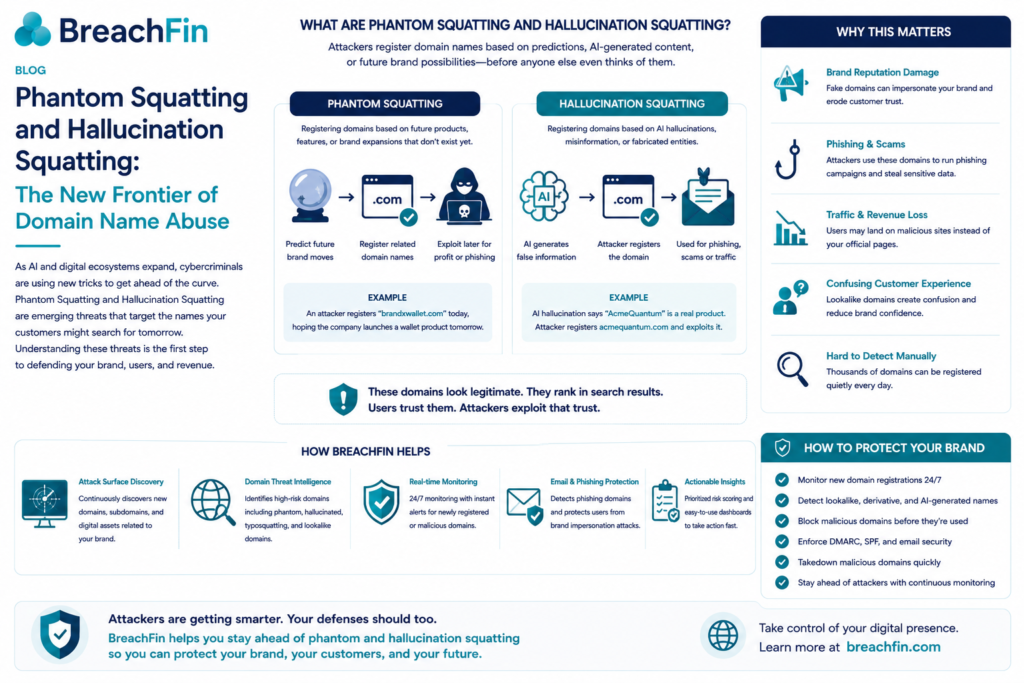
What Is Phantom Squatting?
Phantom Squatting is the practice of registering domain names for products, services, business initiatives, or brands that do not yet exist, but are likely to exist in the future.
Attackers anticipate:
- Future product launches
- Company acquisitions
- Brand expansions
- New business units
- Cryptocurrency projects
- AI products
- Banking services
- Mobile applications
Rather than impersonating an existing website, attackers bet on what an organization might launch next.
When that product eventually becomes public, the malicious domain is already owned.
Example of Phantom Squatting
Imagine a fintech company named AcmePay.
The company plans to launch:
- Acme Wallet
- Acme Rewards
- Acme AI
- Acme Identity
Months before the announcement, attackers register:
- acmewallet.com
- acmerewards.com
- acmeidentity.com
- acmeai.com
When customers search for the new service, malicious domains may already appear in search engines or phishing campaigns.
What Is Hallucination Squatting?
Hallucination Squatting is a newer attack that exploits AI-generated hallucinations.
Large Language Models occasionally generate:
- Incorrect company names
- Fake products
- Nonexistent software
- Imaginary APIs
- Fabricated open-source packages
- Incorrect documentation
- Nonexistent websites
Attackers monitor these hallucinations and register the suggested domains before anyone notices.
When users trust the AI-generated recommendation, they unknowingly visit attacker-controlled websites.
Example of Hallucination Squatting
Suppose an AI assistant responds to a user with:
“Download the SecureQuantum SDK from securequantum.io.”
The domain securequantum.io does not actually belong to a legitimate company—it was fabricated by the AI.
An attacker registers the domain and creates a convincing website containing:
- Malware
- Credential harvesting pages
- Fake software downloads
- API keys
- Cryptocurrency wallet stealers
Because users trust the AI’s recommendation, they are more likely to visit the malicious site.
Why These Attacks Are Growing
Several trends make Phantom Squatting and Hallucination Squatting increasingly attractive to attackers.
AI Adoption
Millions of users now rely on AI assistants for recommendations, research, and coding assistance.
Attackers recognize that users often trust AI-generated answers without independently verifying domain ownership.
Rapid Product Innovation
Organizations release new products more frequently than ever before.
Cybercriminals can predict naming conventions and secure related domains before marketing teams announce new initiatives.
Search Engine Trust
Newly registered domains can quickly appear in search results through SEO manipulation or paid advertisements.
Users may struggle to distinguish legitimate domains from malicious ones.
Brand Expansion
Large enterprises continually introduce new services, increasing opportunities for attackers to register plausible domain names before official launches.
Risks to Organizations
Brand Impersonation
Attackers can create websites that closely resemble official services, damaging customer trust and brand reputation.
Phishing Campaigns
Fraudulent domains may host login pages designed to steal:
- Customer credentials
- Banking information
- MFA tokens
- API keys
Malware Distribution
Attackers may distribute:
- Fake software updates
- Trojanized applications
- Malicious browser extensions
- Cryptocurrency wallet malware
Supply Chain Attacks
Developers relying on AI-generated recommendations may unknowingly download malicious packages or software from attacker-controlled domains.
Customer Confusion
Customers searching for newly announced services may encounter fraudulent websites before official domains are widely recognized.
Phantom Squatting vs. Hallucination Squatting
| Phantom Squatting | Hallucination Squatting |
|---|---|
| Predicts future products or brands | Exploits AI-generated misinformation |
| Based on business predictions | Based on AI hallucinations |
| Targets marketing and branding | Targets AI users and developers |
| Often registered before announcements | Registered after AI invents names |
| Used for phishing and impersonation | Used for malware, scams, and fake resources |
Best Practices for Organizations
Register Strategic Domains Early
Reserve domains related to future products, services, and likely naming conventions before public announcements.
Monitor New Domain Registrations
Continuously monitor newly registered domains that resemble your:
- Brand
- Products
- Executive names
- Subsidiaries
- APIs
Early detection allows organizations to respond before attackers gain traction.
Validate AI Recommendations
Employees and developers should verify AI-generated URLs, repositories, software packages, and documentation before using them.
Strengthen Email Security
Implement:
- SPF
- DKIM
- DMARC
to reduce the effectiveness of phishing campaigns originating from malicious domains.
Educate Employees
Security awareness training should now include AI-related risks, including hallucinated websites and fabricated software recommendations.
How BreachFin Helps
Protecting against emerging domain-based threats requires continuous visibility across the digital ecosystem.
BreachFin helps organizations strengthen their security posture by identifying risks before attackers can exploit them.
Attack Surface Discovery
Continuously discover newly registered domains, subdomains, and internet-facing assets associated with your organization.
Domain Threat Intelligence
Identify suspicious domains, including phantom, hallucination, typo, combo, and lookalike registrations that could be used for phishing or impersonation.
Continuous Monitoring
Receive alerts when high-risk domains, digital assets, or brand references appear online, enabling faster investigation and response.
Phishing Protection
Monitor for malicious websites targeting your customers, employees, or partners and support rapid mitigation efforts.
Actionable Risk Insights
Prioritize domain-related threats using continuous monitoring and intelligence, helping security teams focus on the most significant risks.
The Future of Domain Security
Artificial intelligence is changing how people discover information, interact with software, and make decisions online. Unfortunately, attackers are adapting just as quickly.
Phantom Squatting and Hallucination Squatting demonstrate that cybercriminals no longer need to wait for a product launch or compromise a legitimate website—they can exploit predictions and AI-generated content before an organization is even aware of the risk.
As AI-driven search, coding assistants, and digital experiences become more common, organizations must expand their brand protection strategy beyond traditional typosquatting defenses.
Conclusion
Domain abuse has evolved beyond simple misspellings. Phantom Squatting and Hallucination Squatting represent a new generation of attacks that exploit future brand opportunities and AI-generated misinformation to deceive users and compromise trust.
Organizations that continuously monitor their digital footprint, validate AI-generated resources, and proactively protect their brand are better positioned to reduce cyber risk and maintain customer confidence.
At BreachFin, we help organizations identify emerging threats across domains, cloud infrastructure, APIs, and client-side environments. Through continuous monitoring and actionable threat intelligence, businesses can stay ahead of evolving attack techniques and protect what matters most—their brand, customers, and digital ecosystem.