Quantum Computing Could Redefine Cryptography
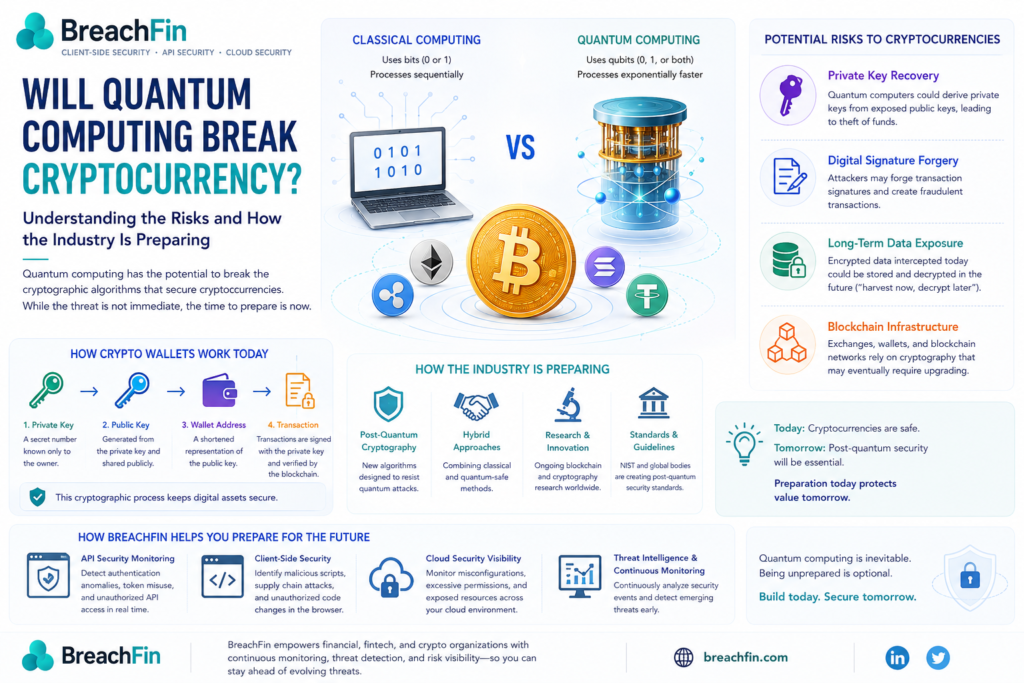
Quantum computing has long been viewed as one of the most disruptive technologies of the future. While today’s computers solve problems using binary bits (0s and 1s), quantum computers use qubits, allowing them to process certain calculations exponentially faster than classical systems.
This breakthrough has enormous potential for medicine, logistics, scientific research, and artificial intelligence—but it also raises an important question for the financial industry:
What happens when quantum computers become powerful enough to break today’s cryptography?
For cryptocurrencies, blockchain networks, and digital asset platforms, the answer could reshape the future of security.
Why Cryptography Matters in Cryptocurrency
Every blockchain relies on cryptography to ensure trust.
Cryptography protects:
- Wallet ownership
- Private keys
- Digital signatures
- Transaction authenticity
- Blockchain integrity
- User identities
Without strong cryptography, anyone could potentially forge transactions or steal digital assets.
Today’s cryptocurrencies rely heavily on Elliptic Curve Cryptography (ECC) and secure hashing algorithms to protect billions of dollars in value.
How Crypto Wallets Work Today
Every cryptocurrency wallet contains:
- Private Key – A secret number known only to the wallet owner.
- Public Key – Generated from the private key and shared publicly.
- Wallet Address – A shortened representation of the public key.
When users send cryptocurrency:
- The wallet signs the transaction using the private key.
- The blockchain verifies the digital signature.
- The transaction is permanently recorded.
Because deriving the private key from the public key is computationally infeasible with today’s computers, digital assets remain secure.
Where Quantum Computing Changes Everything
Quantum computers introduce new mathematical capabilities.
One of the most significant is Shor’s Algorithm, which can efficiently solve mathematical problems that underpin many public-key cryptographic systems.
If large-scale fault-tolerant quantum computers become practical, they could potentially derive private keys from exposed public keys much faster than classical computers.
This creates risks for blockchain systems that rely on traditional public-key cryptography.
Is Bitcoin at Immediate Risk?
The short answer is no.
Today’s quantum computers are far from capable of breaking Bitcoin or Ethereum’s cryptography at scale.
Current quantum devices:
- Have relatively few stable qubits.
- Experience high error rates.
- Cannot yet perform the enormous number of reliable operations required to attack production cryptocurrency wallets.
Researchers estimate that breaking modern cryptographic keys would require quantum hardware far beyond what is currently available.
However, many experts believe organizations should begin preparing now because cryptographic migrations can take years.
Potential Risks for Cryptocurrencies
If practical quantum computers emerge without corresponding cryptographic upgrades, several risks could arise.
Private Key Recovery
If attackers can derive private keys from exposed public keys, they could potentially steal funds from vulnerable wallets.
Digital Signature Forgery
Quantum attacks could enable fraudulent transaction signatures if existing algorithms become breakable.
Long-Term Data Exposure
Sensitive encrypted data intercepted today could be stored and decrypted in the future once sufficiently powerful quantum computers exist. This is often called “harvest now, decrypt later.”
Blockchain Infrastructure
Exchanges, wallets, payment providers, and blockchain APIs all rely on cryptographic protocols that may eventually require migration to post-quantum cryptography (PQC).
How the Crypto Industry Is Preparing
The industry is not standing still.
Researchers and standards bodies are actively developing quantum-resistant algorithms.
Recent efforts include:
- Post-quantum digital signatures
- Quantum-resistant key exchange
- Hybrid cryptographic approaches
- New blockchain research
- Quantum-safe wallet architectures
In 2024, the U.S. National Institute of Standards and Technology (NIST) finalized its first set of post-quantum cryptography standards, providing organizations with algorithms designed to resist attacks from future quantum computers.
Why Continuous Monitoring Still Matters
Quantum computing is only one of many risks facing digital asset platforms.
Today, crypto organizations continue to face:
- API attacks
- Wallet compromises
- Supply chain attacks
- Smart contract vulnerabilities
- Client-side attacks
- Cloud misconfigurations
- Credential theft
Preparing for future quantum threats should not distract organizations from addressing the threats they face today.
How BreachFin Helps Prepare for the Future
While quantum-resistant cryptography continues to evolve, organizations can strengthen their security posture today through continuous monitoring and proactive risk management.
API Security Monitoring
BreachFin continuously monitors APIs for:
- Authentication anomalies
- Token misuse
- Unauthorized requests
- Abnormal API behavior
Protecting the interfaces that connect modern financial systems.
Client-Side Security
Many attacks begin inside the browser.
BreachFin helps detect:
- Malicious JavaScript
- Third-party supply chain attacks
- Browser manipulation
- Unauthorized code changes
Protecting customers before transactions are initiated.
Cloud Security Visibility
Digital asset platforms rely heavily on cloud infrastructure.
BreachFin continuously identifies:
- IAM misconfigurations
- Excessive permissions
- Exposed storage
- Configuration drift
- Infrastructure risks
Reducing operational exposure across cloud environments.
Threat Intelligence & Continuous Monitoring
BreachFin provides ongoing visibility into:
- Authentication events
- Infrastructure changes
- API activity
- Security anomalies
- Third-party dependencies
Continuous monitoring helps organizations detect emerging threats long before they become major incidents.
Preparing for a Post-Quantum Future
Organizations should begin planning today by:
- Inventorying cryptographic assets.
- Tracking dependencies on current cryptographic algorithms.
- Monitoring guidance from standards bodies such as NIST.
- Evaluating vendor readiness for post-quantum cryptography.
- Designing systems that can support future cryptographic upgrades.
- Implementing continuous security monitoring to reduce present-day risk.
Preparing early makes future transitions significantly easier.
Final Thoughts
Quantum computing represents one of the most significant technological shifts on the horizon. Although today’s quantum computers cannot yet break major cryptocurrencies, the long-term implications for cryptography are substantial.
The good news is that the cybersecurity and blockchain communities are already developing quantum-resistant standards and migration strategies. Organizations that understand their cryptographic dependencies, monitor emerging risks, and invest in adaptable security architectures will be better positioned for the future.
At BreachFin, we believe security is not only about defending against today’s threats—it is also about preparing for tomorrow’s. Continuous monitoring, proactive risk management, and resilient architectures remain essential as the digital asset ecosystem evolves toward a post-quantum world.