Artificial Intelligence is rapidly becoming part of nearly every modern application—from customer service chatbots and code assistants to fraud detection systems and enterprise automation. However, while organizations focus on AI performance and innovation, many overlook a growing cybersecurity concern: the AI supply chain.
Recent industry research and cybersecurity reporting show increasing concern about vulnerabilities in AI components, model repositories, datasets, and third-party integrations. Experts warn that organizations are repeating many of the same software supply chain mistakes made during the early adoption of open-source software, but at a much faster pace.
Just as software dependencies transformed application development, AI components are transforming how organizations build intelligent systems. Every model, dataset, plugin, and API added to an application expands the organization’s attack surface.
What Is the AI Supply Chain?
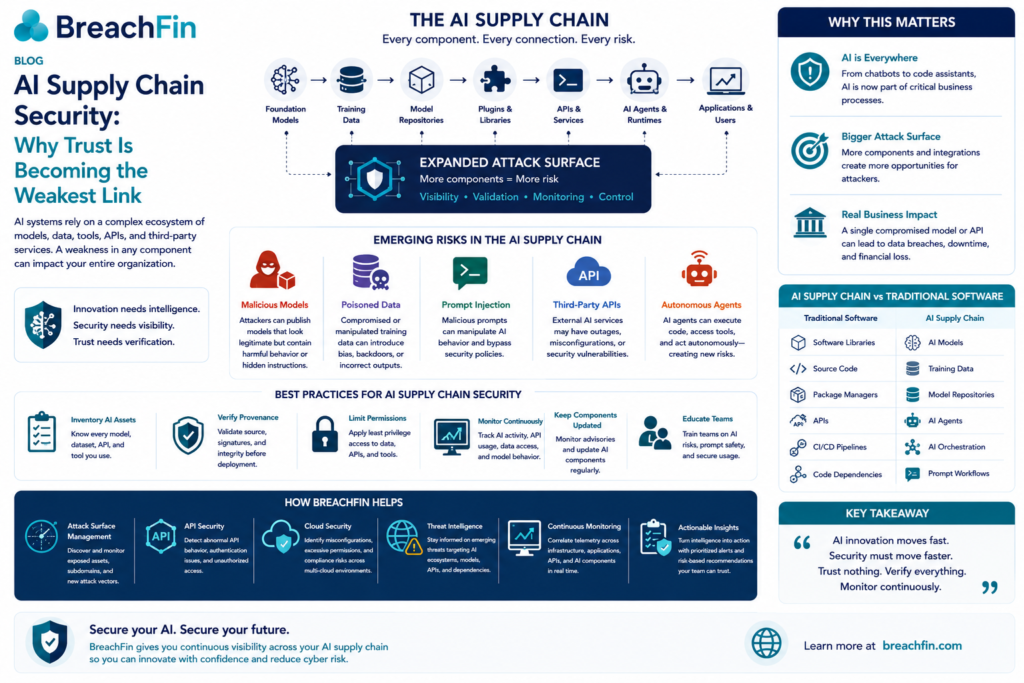
The AI supply chain consists of every component that contributes to building, training, deploying, and operating an AI-powered application.
These components include:
- Foundation models
- Open-source AI models
- Model repositories
- Training datasets
- Vector databases
- AI plugins
- APIs
- AI agents
- Prompt libraries
- Machine learning frameworks
Each component may originate from a different vendor or community, making visibility and trust increasingly difficult.
Why AI Supply Chains Are Different
Traditional software dependencies are largely static.
AI ecosystems are dynamic.
Models are:
- Frequently updated
- Fine-tuned
- Retrained
- Connected to external tools
- Granted access to sensitive enterprise data
This means organizations must secure not only the software but also the behavior and provenance of AI components.
Emerging AI Supply Chain Risks
Malicious Models
An attacker can publish a model that appears legitimate but contains unsafe behavior, hidden instructions, or manipulated outputs.
Organizations downloading models without verifying their origin risk introducing malicious functionality into production environments.
Poisoned Training Data
AI models are only as trustworthy as the data used to train them.
Compromised or manipulated datasets can introduce:
- Biased outputs
- Incorrect responses
- Hidden backdoors
- Data leakage
- Unsafe recommendations
Prompt Injection
Attackers increasingly exploit prompt injection to manipulate AI behavior.
Malicious prompts can cause AI systems to:
- Reveal confidential information
- Ignore security policies
- Execute unauthorized actions
- Access connected tools
Third-Party AI APIs
Many applications rely on external AI services.
If these APIs experience outages, security issues, or configuration errors, downstream applications may also be affected.
Autonomous AI Agents
Modern AI agents can browse websites, execute code, interact with APIs, and automate workflows.
Without proper controls, compromised agents could increase operational and security risks.
Why This Matters for Enterprises
Organizations increasingly integrate AI into critical business processes.
Examples include:
- Customer support
- Financial services
- Software development
- HR automation
- Healthcare
- Fraud detection
- Identity verification
A weakness in any AI component can affect confidentiality, integrity, and availability across the broader enterprise.
Best Practices for Securing the AI Supply Chain
Inventory AI Assets
Maintain a complete inventory of:
- AI models
- APIs
- Plugins
- Datasets
- External services
You cannot secure assets you cannot see.
Verify Provenance
Only deploy AI components from trusted sources.
Validate:
- Publisher identity
- Digital signatures
- Repository integrity
- Version history
Limit AI Permissions
Apply the principle of least privilege.
AI systems should access only the data and services required to perform their intended function.
Monitor AI Activity
Continuously monitor:
- API usage
- Model interactions
- Network activity
- Authentication events
- Data access
- Prompt behavior
Visibility is essential for detecting abnormal AI activity before it becomes a security incident.
Keep AI Components Updated
Monitor security advisories for AI frameworks, libraries, and model ecosystems.
As AI adoption grows, vulnerabilities affecting AI tooling are expected to become more common.
AI Supply Chain Security vs Traditional Software Supply Chain
| Traditional Software | AI Supply Chain |
|---|---|
| Software libraries | AI models |
| Source code | Training datasets |
| Package managers | Model repositories |
| APIs | AI agents |
| Code dependencies | Prompt workflows |
| CI/CD pipelines | AI orchestration |
How BreachFin Helps
As organizations adopt AI at scale, security teams require continuous visibility across both traditional infrastructure and AI-enabled environments.
BreachFin helps organizations reduce cyber risk through proactive monitoring and intelligence.
Attack Surface Management
Identify exposed services, APIs, cloud resources, and internet-facing assets before attackers discover them.
API Security
Monitor API authentication, abnormal traffic patterns, and AI-driven integrations to detect misuse early.
Cloud Security
Continuously identify configuration drift, excessive permissions, and cloud misconfigurations.
Threat Intelligence
Stay informed about emerging threats targeting AI ecosystems, software supply chains, and third-party dependencies.
Continuous Monitoring
Correlate telemetry across cloud infrastructure, APIs, client-side applications, and digital assets to provide actionable security insights.
Looking Ahead
Artificial intelligence is reshaping software development, but it also introduces a new layer of supply chain risk. Organizations that adopt AI without evaluating the trustworthiness of models, datasets, and external services may unknowingly increase their attack surface.
As AI becomes embedded in critical business operations, continuous monitoring, strong governance, and rigorous validation of AI components will be essential to maintaining resilience.
Conclusion
The AI supply chain is quickly becoming one of the most important frontiers in enterprise cybersecurity. Every model, dataset, API, and integration represents both an opportunity for innovation and a potential avenue for attack.
Organizations that build visibility into their AI ecosystems, verify the provenance of AI components, and continuously monitor AI activity will be better positioned to manage evolving risks.
At BreachFin, we help organizations strengthen their security posture through continuous monitoring, attack surface management, API security, cloud security, and actionable threat intelligence—enabling businesses to innovate with confidence while reducing cyber risk.