Introduction
Artificial intelligence is moving beyond chatbots.
Modern AI agents can retrieve information, call APIs, access databases, interact with SaaS applications, execute workflows, and take actions on behalf of users.
To make this possible, AI systems need a standardized way to communicate with external tools and data sources.
One of the most important emerging technologies addressing this problem is the Model Context Protocol (MCP).
MCP is rapidly becoming part of the infrastructure connecting AI models to tools, applications, and enterprise data. But every new connection creates a new security boundary.
The question organizations need to ask is no longer simply:
“Is our AI model secure?”
It is:
“Can we trust everything the AI model can access and everything it can do?”
What Is MCP?
The Model Context Protocol (MCP) provides a standardized way for AI applications to interact with external systems.
An MCP-enabled AI application can connect to servers that expose capabilities such as:
- Databases
- File systems
- APIs
- Git repositories
- SaaS platforms
- Cloud services
- Internal enterprise tools
Instead of building a custom integration for every AI application, MCP provides a common protocol for exposing tools and resources.
This makes AI integrations easier to build—but it also creates a new security layer that organizations need to govern.
Why MCP Changes the AI Attack Surface
Traditional applications usually have clearly defined interfaces.
AI agents introduce a different model.
An agent can dynamically decide:
- What information it needs
- Which tool to use
- Which API to call
- What information to provide to the tool
- What action to take based on the result
That means an attacker may not need to compromise the AI model itself.
Instead, they may target the tools, permissions, credentials, APIs, or context surrounding the model.
This creates a new attack surface.
Understanding the MCP Architecture
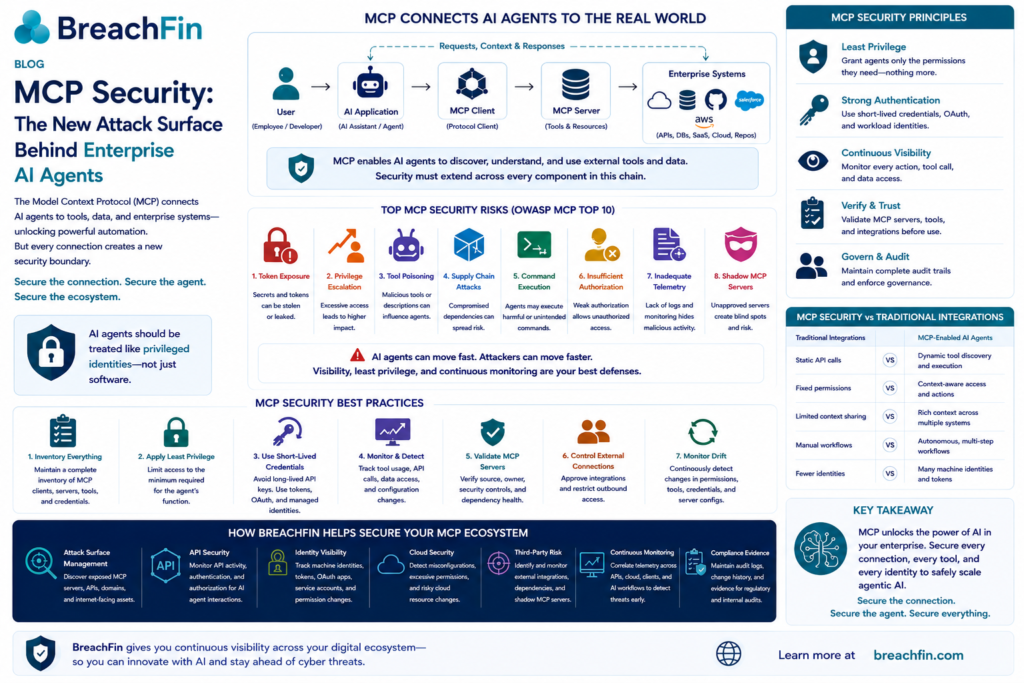
A simplified MCP environment may look like this:
User → AI Application → MCP Client → MCP Server → Enterprise System
For example:
Employee → AI Assistant → MCP → Salesforce
The AI assistant could potentially retrieve customer information through the MCP server.
Another workflow might look like:
Developer → AI Coding Agent → MCP → GitHub
The agent could potentially read repositories, create issues, or interact with development systems.
The security of the entire workflow therefore depends on more than the AI model.
Every component must be trusted and governed.
The Major MCP Security Risks
OWASP’s MCP Top 10 identifies several security concerns specifically associated with MCP environments. These include token exposure, privilege escalation, tool poisoning, software supply-chain attacks, command execution, insufficient authorization, inadequate telemetry, shadow MCP servers, and context injection.
1. Token Mismanagement and Secret Exposure
MCP environments may interact with:
- OAuth tokens
- API keys
- Cloud credentials
- Database credentials
- Service accounts
Long-lived or poorly protected credentials can turn a compromised AI workflow into a pathway to sensitive systems.
Security Principle
AI agents should not receive unrestricted, long-lived credentials.
Use short-lived, narrowly scoped credentials wherever possible.
2. Privilege Escalation and Scope Creep
An AI agent may initially require read-only access.
Over time, additional permissions may be added:
- Write access
- Administrative access
- Production access
- Customer data access
This creates permission creep.
An AI agent that originally needed to read data may eventually have the ability to modify or delete it.
Least privilege should therefore apply to AI agents just as it does to human identities.
3. Tool Poisoning
One of the most interesting MCP-specific risks is tool poisoning.
An attacker may compromise a tool, its metadata, its description, or its output and attempt to influence how an AI agent uses it.
For example, an apparently harmless tool might contain hidden instructions that attempt to influence the agent into:
- Disclosing sensitive information
- Calling another tool
- Sending data externally
- Performing unauthorized actions
The danger is that AI agents interpret natural-language information as part of their decision-making process.
Tool descriptions therefore become part of the security boundary.
4. MCP Supply Chain Attacks
MCP servers and connectors can depend on:
- Open-source packages
- Third-party libraries
- External APIs
- Developer-maintained repositories
- Cloud services
A compromised dependency can therefore affect the AI workflow above it.
Organizations should evaluate MCP components with the same supply-chain discipline applied to traditional software.
5. Insufficient Authentication and Authorization
An MCP server should never assume that a request is trustworthy simply because it originates from an AI application.
Security controls should establish:
- Who is requesting access
- Which agent is making the request
- What the agent is allowed to access
- Which tool it is allowed to invoke
- What actions are permitted
- How sensitive data should be handled
Authorization must be enforced at the tool and resource level—not merely at the application perimeter.
6. Shadow MCP Servers
Developers experimenting with AI may deploy MCP servers without going through traditional security or IT approval processes.
This can create Shadow MCP infrastructure.
Security teams may not know:
- Where the server is running
- What data it can access
- Which credentials it uses
- Who operates it
- Which AI agents can connect to it
This is similar to Shadow IT—but potentially more dangerous because an MCP server can provide an AI agent with direct access to enterprise systems.
7. Context Injection and Over-Sharing
AI systems depend heavily on context.
The more information an agent receives, the more capable it may become.
But excessive context can create information leakage.
Sensitive information from one workflow could potentially become available to another if boundaries are poorly designed.
Organizations should carefully control:
- What context an agent receives
- How long context is retained
- Which users can access it
- Which tools can consume it
- Whether sensitive data can cross trust boundaries
MCP Security Requires More Than Model Security
A common mistake is to focus exclusively on securing the underlying LLM.
But an AI agent is an ecosystem.
Consider:
Model + Agent + MCP Client + MCP Server + API + Identity + Data + Cloud
If any component is compromised, the overall workflow may be affected.
This means AI security must include:
- Identity security
- API security
- Cloud security
- Application security
- Supply-chain security
- Data security
- Runtime monitoring
MCP and OAuth Security
MCP’s security model increasingly relies on modern authorization mechanisms.
The July 28, 2026 MCP specification introduced additional authorization hardening, including issuer validation and stronger credential binding, while moving away from Dynamic Client Registration toward Client ID Metadata Documents.
This reinforces an important security principle:
Authentication establishes who you are. Authorization establishes what you are allowed to do.
For MCP deployments, both need to be enforced consistently.
MCP Security Best Practices
1. Build an MCP Inventory
Know every:
- MCP client
- MCP server
- Tool
- Connector
- API
- Identity
- Credential
connected to your environment.
2. Apply Least Privilege
Give agents only the permissions required for their intended tasks.
A read-only agent should not have write permissions simply because the underlying API supports them.
3. Use Short-Lived Credentials
Avoid unnecessary long-lived API keys and static credentials.
Use:
- OAuth
- Short-lived tokens
- Workload identities
- Scoped credentials
- Managed identities
where appropriate.
4. Monitor Tool Usage
Record:
- Agent identity
- User identity
- Tool invocation
- API request
- Resource accessed
- Result
- Timestamp
Without telemetry, investigating an AI-driven security event becomes significantly harder.
5. Validate MCP Servers
Before allowing an MCP server into production, evaluate:
- Source
- Ownership
- Dependencies
- Authentication
- Authorization
- Network exposure
- Logging
- Data access
- Credential handling
6. Control External MCP Connections
Do not allow enterprise AI systems to connect to arbitrary MCP servers without governance.
Establish an approval process for external tools and integrations.
7. Monitor for Configuration Drift
An MCP server that was secure yesterday may not be secure tomorrow.
Changes to:
- Permissions
- Credentials
- Tools
- Dependencies
- APIs
- Network access
should be monitored continuously.
MCP Security and Compliance
MCP security can support broader security and compliance programs based on frameworks such as:
- NIST Cybersecurity Framework
- NIST SP 800-53
- ISO/IEC 27001
- SOC 2
- PCI DSS
- OWASP security guidance
The objective should not be to treat MCP as a completely separate security program.
Instead, MCP should become part of the organization’s existing:
Identity + API + Cloud + Application + Data + Supply Chain security strategy.
How BreachFin Can Help
MCP introduces another layer of APIs, integrations, identities, and external dependencies.
This fits directly into the broader digital attack surface that BreachFin is designed to help organizations understand.
Attack Surface Management
Discover externally exposed services, APIs, domains, and infrastructure that may support AI and MCP workloads.
API Security
Monitor APIs that connect AI agents to enterprise systems and identify authentication, authorization, and exposure risks.
Identity Visibility
Track service identities, OAuth integrations, credentials, and permission changes associated with AI-enabled workflows.
Third-Party Risk
Identify external integrations and dependencies that introduce additional trust relationships into an organization’s environment.
Continuous Security Monitoring
Monitor changes across cloud environments, APIs, client-side applications, and digital infrastructure to identify unexpected security changes.
Compliance Evidence
Maintain security monitoring and change history that can contribute to broader audit and compliance programs.
BreachFin’s existing platform focuses on areas such as external attack-surface visibility, client-side runtime monitoring, SaaS/OAuth integration visibility, cryptographic risk, and compliance evidence—making MCP monitoring a natural extension of the broader digital ecosystem security model.
The Future of MCP Security
MCP is evolving rapidly.
The July 2026 specification moved MCP toward a stateless protocol core, introduced additional authorization hardening, formalized extensions, and added changes intended to improve scalability and enterprise deployment.
As MCP becomes more deeply integrated into enterprise AI, security teams should expect the ecosystem to become more sophisticated as well.
The organizations that succeed will not simply deploy AI agents quickly.
They will deploy them with identity, authorization, monitoring, governance, and accountability built in from the beginning.
Conclusion
MCP is helping transform AI from a conversational technology into an operational platform.
An AI agent can now potentially interact with the same systems that employees and applications use every day.
That capability creates enormous business value—but it also creates a new security boundary.
The security question is no longer only:
“Can we secure the AI model?”
It is:
“Can we secure everything the AI can see, access, and control?”
Organizations should treat MCP servers and AI tools as part of their enterprise attack surface. Strong authentication, least privilege, secure credential management, tool validation, supply-chain controls, and continuous monitoring will be essential as agentic AI becomes increasingly connected to production systems.
At BreachFin, we believe AI security must extend beyond the model. Every API, identity, integration, cloud resource, and external dependency connected to an AI workflow should be visible, governed, and continuously monitored.
Secure the connection. Secure the agent. Secure the digital ecosystem.