Modern Websites Face a New Kind of Threat
Today’s websites are more interactive than ever. They load content from payment processors, analytics platforms, chat applications, marketing tools, content delivery networks (CDNs), and dozens of third-party services.
While these integrations improve the user experience, they also increase the risk of malicious JavaScript executing inside the browser.
One compromised script can steal payment card information, capture login credentials, or redirect users to malicious websites.
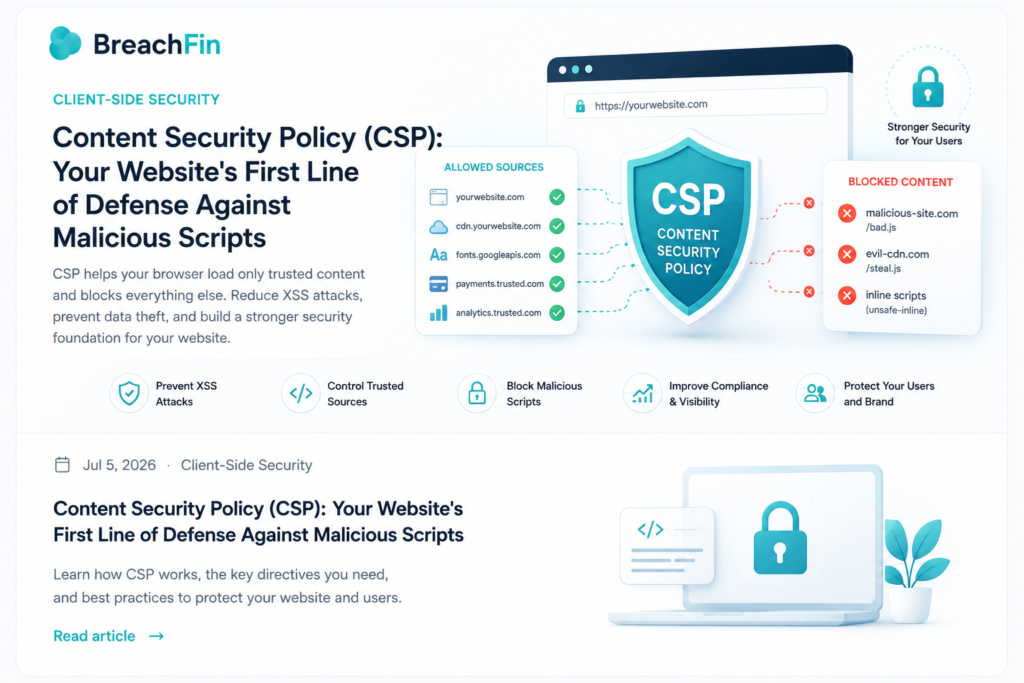
A Content Security Policy (CSP) helps reduce this risk by telling the browser exactly what content is allowed to load—and blocking everything else.
What Is Content Security Policy?
Content Security Policy (CSP) is a browser security standard that allows website owners to define trusted sources for content such as:
- JavaScript
- CSS
- Images
- Fonts
- Videos
- Frames
- APIs
Instead of allowing browsers to execute code from anywhere, CSP creates an allowlist of approved sources.
If unauthorized content attempts to load, the browser blocks it automatically.
Why CSP Matters
Without a Content Security Policy, browsers generally trust any script included on a webpage.
If an attacker injects malicious JavaScript through:
- Cross-Site Scripting (XSS)
- A compromised third-party library
- Browser extensions
- Supply chain attacks
- Unauthorized code changes
the browser may execute it without warning.
CSP significantly reduces this risk by preventing unapproved code from running.
Common Threats CSP Helps Prevent
Cross-Site Scripting (XSS)
XSS attacks inject malicious JavaScript into legitimate websites.
Attackers use these scripts to:
- Steal session cookies
- Capture credentials
- Modify webpage content
- Redirect users
- Execute malicious code
A properly configured CSP makes many XSS attacks far more difficult.
Malicious Third-Party Scripts
Organizations rely on external services for:
- Analytics
- Payment processing
- Live chat
- Advertising
- Customer feedback
If one of these providers becomes compromised, malicious scripts may be distributed to every connected website.
CSP restricts which domains are allowed to deliver JavaScript.
Data Exfiltration
Some attacks attempt to send sensitive customer information to attacker-controlled servers.
A Content Security Policy can limit which domains browsers are allowed to communicate with, helping prevent unauthorized data transmission.
Key CSP Directives
A Content Security Policy typically controls:
Script Sources
Specify where JavaScript can load from.
Example:
- Your own domain
- Trusted CDN
- Approved payment provider
Style Sources
Restrict CSS files to trusted locations.
Image Sources
Allow images only from approved domains.
Frame Sources
Limit which websites can be embedded using iframes.
This helps reduce clickjacking and malicious embedded content.
Connection Sources
Control where applications can send AJAX requests, WebSocket connections, and API traffic.
Best Practices for Implementing CSP
Start in Report-Only Mode
Before enforcing a policy, enable reporting to identify legitimate resources that would otherwise be blocked.
This minimizes disruption while refining the policy.
Avoid Wildcards
Policies such as:
script-src *
provide little protection.
Instead, explicitly approve only trusted domains.
Review Third-Party Integrations
Every new integration should be evaluated before being added to the CSP allowlist.
Remove domains that are no longer required.
Update Policies Regularly
As applications evolve, CSP policies should be reviewed to ensure they continue reflecting the current architecture.
Combine CSP with Continuous Monitoring
A Content Security Policy is powerful, but it should not be your only defense.
Continuous monitoring helps identify:
- Unauthorized script changes
- New third-party dependencies
- Suspicious browser activity
- Unexpected outbound connections
Together, CSP and monitoring provide stronger client-side protection.
CSP and PCI DSS 4.0.1
PCI DSS 4.0.1 emphasizes protecting payment pages from unauthorized script activity.
While CSP alone does not satisfy all PCI DSS requirements, it supports compliance by:
- Limiting trusted script sources
- Reducing script injection risks
- Strengthening browser security
- Supporting payment page integrity
Organizations should combine CSP with script inventory management and continuous client-side monitoring.
Benefits of Content Security Policy
Implementing CSP helps organizations:
- Reduce Cross-Site Scripting (XSS) attacks
- Prevent unauthorized JavaScript execution
- Limit third-party security risks
- Improve browser security
- Strengthen payment page protection
- Support compliance initiatives
- Build customer trust
Final Thoughts
As organizations rely more heavily on JavaScript and third-party integrations, browser security has become a critical component of modern cybersecurity. A Content Security Policy gives websites the ability to define what content browsers can trust, reducing the likelihood of malicious scripts executing in users’ browsers.
Although CSP is not a complete security solution, it is one of the most effective controls for mitigating client-side attacks when combined with secure coding practices, script integrity monitoring, and continuous security visibility.
Implementing CSP today is a practical step toward building more resilient and trustworthy web applications.