Organizations have traditionally relied on annual penetration tests and periodic vulnerability assessments to evaluate their security posture. While these assessments remain valuable, today’s threat landscape evolves far faster than yearly testing cycles.
Cloud infrastructure changes daily. APIs are updated continuously. Third-party JavaScript libraries are modified without warning. Developers deploy new code multiple times a day.
The question is no longer:
“Was our environment secure during last year’s penetration test?”
Instead, organizations should ask:
“Is our environment secure right now?”
This is where Continuous Security Validation (CSV) becomes essential.
What Is Continuous Security Validation?
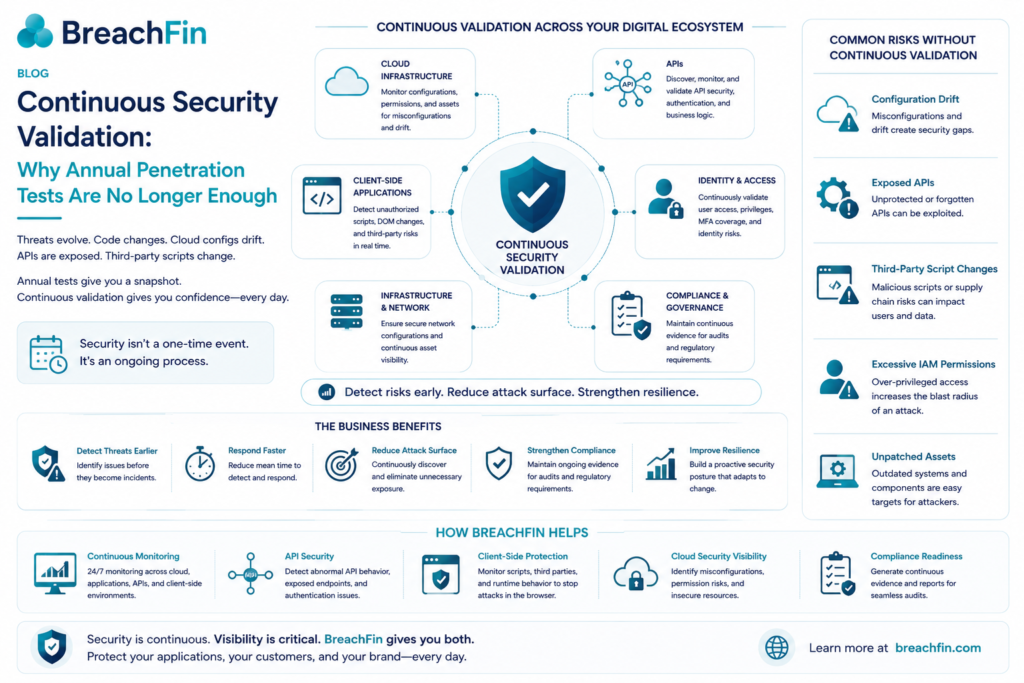
Continuous Security Validation is the ongoing process of verifying that security controls remain effective as systems, applications, cloud infrastructure, and business processes change.
Unlike traditional assessments, continuous validation operates throughout the year.
It evaluates whether:
- Security controls remain effective
- New assets introduce risk
- Configurations drift from secure baselines
- APIs expose unintended functionality
- Client-side scripts change unexpectedly
- Identity permissions become excessive
Why Traditional Assessments Are No Longer Enough
A penetration test provides a snapshot in time.
But organizations may experience:
- Hundreds of code deployments
- New cloud resources
- IAM policy changes
- New APIs
- Third-party software updates
- Infrastructure migrations
between two assessments.
Risks introduced after the assessment may remain unnoticed for months.
Where Continuous Validation Adds Value
Cloud Infrastructure
Monitor for:
- Public storage buckets
- Excessive IAM permissions
- Configuration drift
- Internet-exposed resources
APIs
Continuously validate:
- Authentication enforcement
- Authorization controls
- Sensitive data exposure
- Business logic vulnerabilities
- Unexpected endpoints
Client-Side Applications
Modern attacks increasingly target browsers.
Continuous monitoring detects:
- New third-party JavaScript
- Script integrity changes
- Magecart-style attacks
- DOM manipulation
- Unauthorized resource loading
Identity & Access
Security teams should continuously verify:
- Privileged accounts
- Dormant identities
- Service accounts
- Least-privilege enforcement
- MFA coverage
Business Benefits
Organizations adopting continuous validation gain:
- Earlier threat detection
- Faster incident response
- Reduced attack surface
- Stronger compliance posture
- Better audit evidence
- Improved operational resilience
Continuous Validation and Compliance
Many security frameworks increasingly emphasize ongoing monitoring rather than one-time assessments.
Continuous validation supports organizations implementing:
- PCI DSS 4.0.1
- NIST Cybersecurity Framework
- NIST SP 800-53
- ISO/IEC 27001
- SOC 2
- CIS Controls
Rather than preparing only for audits, organizations maintain a stronger security posture throughout the year.
How BreachFin Helps
BreachFin enables organizations to operationalize continuous security validation by providing visibility across modern digital environments.
Client-Side Security
Monitor runtime JavaScript, third-party scripts, and browser activity to detect unauthorized changes.
API Security
Identify exposed endpoints, authentication anomalies, and abnormal API behavior.
Cloud Security
Continuously detect cloud misconfigurations, excessive permissions, and infrastructure drift.
Continuous Threat Monitoring
Correlate security events across cloud, APIs, and client-side environments to identify emerging risks before they become incidents.
Compliance Readiness
Generate continuous evidence that supports audits and demonstrates ongoing security monitoring.
Final Thoughts
Cybersecurity is no longer a point-in-time exercise. Modern organizations deploy software continuously, adopt new cloud services rapidly, and depend on increasingly complex digital ecosystems.
Security assessments remain valuable, but they should be complemented by continuous validation that confirms security controls remain effective as environments evolve.
Organizations that continuously verify their cloud infrastructure, APIs, client-side applications, and identity systems are better positioned to detect threats early, reduce operational risk, and maintain trust with customers.
At BreachFin, we believe that security should be measured every day—not just during an annual assessment. Continuous visibility helps organizations move from reactive security to proactive resilience.