Applications Are Under Constant Attack
Modern applications face attacks every minute.
Financial institutions, fintech platforms, payment gateways, and SaaS applications process thousands—or even millions—of requests every day. While organizations invest heavily in firewalls, Web Application Firewalls (WAFs), endpoint protection, and vulnerability scanning, attackers continue finding new ways to bypass these defenses.
Why?
Because most traditional security solutions stop at the network edge.
Once malicious traffic reaches the application itself, many attacks become significantly harder to detect.
This is where Runtime Application Self-Protection (RASP) becomes an important part of a defense-in-depth strategy.
What Is Runtime Application Self-Protection?
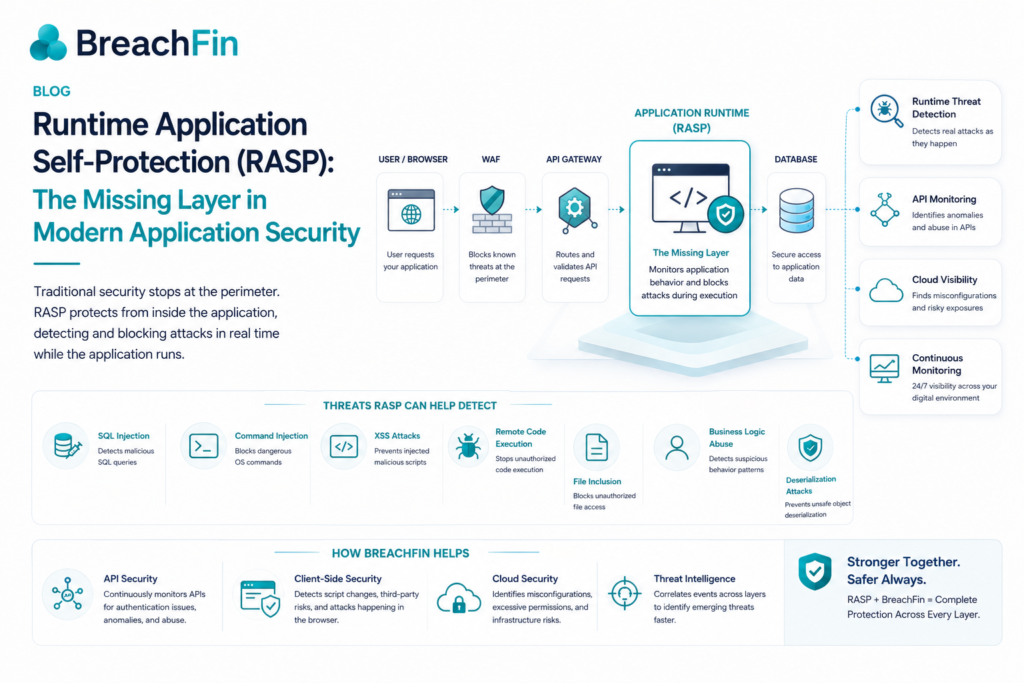
Runtime Application Self-Protection, commonly known as RASP, is a security technology that runs inside an application during execution.
Unlike traditional security tools that inspect traffic from outside the application, RASP understands:
- Application behavior
- User requests
- Executed code
- Database queries
- Business logic
- API interactions
This allows it to identify malicious activity with much greater context.
Instead of asking:
“Does this request look suspicious?”
RASP asks:
“Is this request attempting to exploit the application right now?”
How RASP Differs from a Web Application Firewall
Many organizations assume a WAF provides complete application protection.
While WAFs remain extremely valuable, they operate differently.
| Web Application Firewall | Runtime Application Self-Protection |
|---|---|
| Protects from outside the application | Protects from inside the application |
| Uses signatures and rules | Understands application execution |
| Inspects HTTP traffic | Monitors code execution |
| Blocks known attack patterns | Detects real exploitation attempts |
| Limited application awareness | Full application context |
The two technologies complement—not replace—each other.
Threats RASP Can Help Detect
Because RASP monitors applications during execution, it can help identify attacks such as:
SQL Injection
Detects malicious SQL queries before they reach the database.
Remote Code Execution
Monitors attempts to execute unauthorized code.
Command Injection
Identifies malicious operating system commands triggered by user input.
Cross-Site Scripting (XSS)
Detects injected scripts executing within application workflows.
Deserialization Attacks
Identifies unsafe object deserialization before exploitation.
File Inclusion Attacks
Detects unauthorized attempts to load external files.
Business Logic Abuse
Recognizes suspicious application behavior that traditional security controls may overlook.
Why Runtime Visibility Matters
Modern attacks rarely resemble textbook examples.
Instead, attackers combine:
- Stolen credentials
- API abuse
- Business logic manipulation
- Browser attacks
- Cloud misconfigurations
Many of these attacks appear legitimate until viewed from inside the application.
Runtime visibility provides critical context that perimeter defenses cannot.
Challenges of Runtime Protection
Although RASP provides valuable visibility, organizations should also understand its challenges.
These include:
- Performance considerations
- Application compatibility
- Deployment complexity
- False positives if poorly configured
- Integration with existing security tools
Runtime protection should complement secure development, code reviews, penetration testing, and continuous monitoring.
How BreachFin Complements Runtime Security
Runtime protection is only one piece of modern application security.
BreachFin provides continuous visibility across the broader technology ecosystem, helping organizations identify risks before they become incidents.
Continuous API Monitoring
BreachFin continuously analyzes:
- Authentication behavior
- API anomalies
- Token misuse
- Excessive requests
- Suspicious client activity
Client-Side Security
Many attacks begin before requests ever reach the application.
BreachFin continuously monitors:
- Third-party JavaScript
- Browser behavior
- Script integrity
- Supply chain attacks
- Unauthorized client-side changes
Cloud Security Visibility
Applications depend on cloud infrastructure.
BreachFin identifies:
- IAM risks
- Cloud misconfigurations
- Excessive permissions
- Configuration drift
- Infrastructure exposure
Threat Correlation
Rather than analyzing isolated events, BreachFin correlates:
- API activity
- Authentication events
- Client-side behavior
- Cloud security findings
- Infrastructure changes
This helps security teams identify emerging attack patterns faster.
A Layered Security Strategy
Modern financial platforms should combine multiple security layers, including:
- Secure Software Development Lifecycle (SSDLC)
- Web Application Firewalls
- Runtime protection
- API security
- Cloud security posture management
- Client-side monitoring
- Threat intelligence
- Continuous monitoring
No single technology prevents every attack.
Layered security significantly improves resilience.
Final Thoughts
Attackers continue evolving faster than traditional perimeter defenses.
As applications become more complex, organizations need visibility into what happens not only around their applications—but also inside them.
Runtime Application Self-Protection offers valuable insight into active exploitation attempts by monitoring application behavior during execution. Combined with continuous monitoring of APIs, cloud infrastructure, client-side activity, and authentication events, organizations gain a stronger ability to detect, investigate, and respond to emerging threats.
At BreachFin, we believe effective cybersecurity requires continuous visibility across every layer of the application lifecycle. By combining proactive monitoring with actionable intelligence, organizations can reduce risk, strengthen resilience, and protect the digital experiences their customers rely on every day.