Disclaimer: This article is based on publicly reported information regarding the June 2026 Polymarket incident. According to Polymarket, the compromise originated from a third-party vendor that allowed malicious JavaScript to be injected into portions of its frontend. Polymarket has stated that the issue was contained, the affected dependency removed, and impacted users would be fully reimbursed
Everyone Audits Smart Contracts. Few Monitor the Frontend.
When people think about Web3 security, they usually focus on:
- Smart contract audits
- Wallet security
- Blockchain consensus
- Private key protection
Yet the recent Polymarket incident demonstrated that attackers don’t always target blockchain infrastructure.
Instead, they targeted something much simpler.
A trusted third-party dependency.
According to Polymarket, attackers compromised a third-party vendor and injected malicious JavaScript into the website’s frontend, exposing a small number of users to fraudulent transactions that ultimately resulted in approximately $3 million in losses. The platform later removed the affected dependency and announced full reimbursement for affected users.
The blockchain wasn’t hacked.
The smart contracts weren’t broken.
The website delivering the user experience became the attack surface.
What Happened?
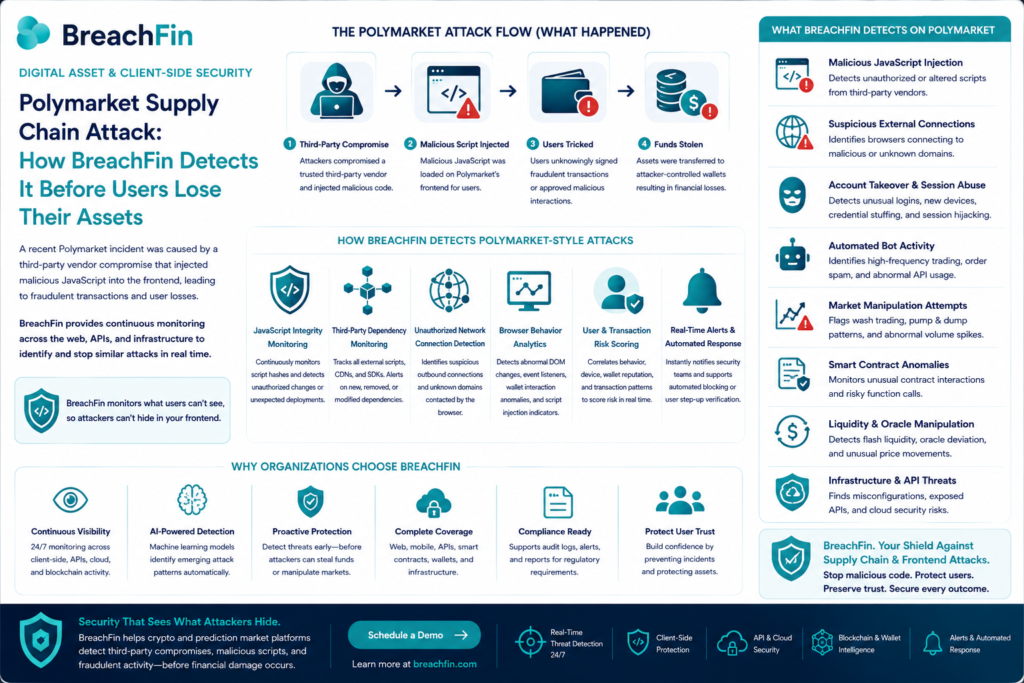
Based on public disclosures, the attack followed a familiar software supply chain pattern.
- A third-party vendor was compromised.
- Malicious JavaScript was injected into Polymarket’s frontend.
- Users loaded the legitimate website.
- The injected code presented or facilitated malicious transaction approvals.
- Users unknowingly authorized transactions.
- Digital assets were transferred to attacker-controlled wallets.
This type of attack is particularly dangerous because users believe they are interacting with the legitimate application.
Why This Attack Was Different
The incident was not primarily:
- a smart contract exploit,
- a blockchain consensus failure,
- or a cryptographic weakness.
Instead, it targeted the Web2 layer supporting a Web3 application.
Modern crypto platforms still depend on:
- JavaScript libraries
- Analytics tools
- CDN-hosted assets
- Third-party SDKs
- Frontend frameworks
- Cloud infrastructure
Every dependency introduces additional risk.
How BreachFin Could Have Helped
BreachFin focuses on continuous visibility rather than periodic security testing.
Instead of waiting for users to report suspicious behavior, BreachFin continuously monitors critical web assets and infrastructure for indicators of compromise.
Continuous JavaScript Integrity Monitoring
One of the first indicators would have been an unexpected change to production JavaScript.
BreachFin continuously monitors:
- JavaScript integrity
- Script hashes
- New script deployments
- Unexpected code modifications
- Third-party dependency changes
If a trusted script suddenly changes without authorization, security teams receive immediate alerts.
Rather than discovering malicious code after customer impact, organizations gain visibility within minutes.
Third-Party Dependency Monitoring
Modern applications often load dozens of external resources.
BreachFin continuously inventories:
- External JavaScript
- Third-party SDKs
- CDN resources
- Browser dependencies
- Embedded widgets
Unexpected additions, removals, or modifications become immediately visible.
Organizations always know exactly what code is executing inside customer browsers.
Unauthorized Network Connection Detection
Injected JavaScript frequently communicates with attacker-controlled infrastructure.
BreachFin monitors browser activity for:
- Unknown outbound requests
- New external domains
- Unexpected API destinations
- Suspicious data transfers
- Abnormal browser communications
Security teams can quickly investigate suspicious destinations before widespread exploitation occurs.
Browser Behavior Analytics
Malicious scripts often behave differently than legitimate application code.
BreachFin identifies:
- New execution paths
- Abnormal DOM modifications
- Unexpected event listeners
- Unauthorized form interception
- Wallet interaction anomalies
Behavioral analysis provides another layer of detection beyond simple file monitoring.
Client-Side Threat Detection
Traditional security tools focus on:
- Servers
- APIs
- Firewalls
- Containers
- Cloud infrastructure
But attacks like the Polymarket incident occur inside the browser.
BreachFin extends visibility directly into the client side, helping organizations identify:
- Script injection
- Supply chain attacks
- Magecart-style behavior
- DOM tampering
- Malicious browser activity
before customers become victims.
Security Alerts Before Financial Loss
Rather than discovering fraud after funds leave customer wallets, BreachFin provides early warning indicators such as:
- Unexpected JavaScript modifications
- Unauthorized third-party changes
- Suspicious browser behavior
- New external network destinations
- Integrity verification failures
These alerts enable rapid investigation and incident response.
Lessons for Every Crypto Platform
The Polymarket incident reinforces several important lessons.
Smart contract audits alone are not enough.
Organizations should also monitor:
- Frontend integrity
- Third-party dependencies
- Client-side JavaScript
- Browser behavior
- Supply chain risks
- API activity
- Cloud infrastructure
Security must extend beyond the blockchain itself.
Why Continuous Monitoring Matters
Supply chain attacks evolve rapidly.
Attackers no longer need to compromise your infrastructure directly.
Instead, they target trusted vendors whose code is automatically delivered to your customers.
Continuous monitoring helps organizations detect:
- Unauthorized frontend changes
- Dependency compromises
- Client-side attacks
- Suspicious browser behavior
- Emerging supply chain threats
before attackers can affect a large number of users.
Final Thoughts
The recent Polymarket incident is a reminder that Web3 applications remain dependent on traditional web technologies. Even when smart contracts are secure, compromised third-party frontend code can expose users to significant financial loss.
For crypto exchanges, prediction markets, stablecoin issuers, and digital asset platforms, security must extend beyond blockchain infrastructure. Continuous monitoring of client-side code, third-party dependencies, browser behavior, and application integrity is becoming just as important as auditing smart contracts.
BreachFin helps organizations close this visibility gap by continuously monitoring the web layer where many modern supply chain attacks begin, allowing security teams to detect anomalies early, investigate faster, and reduce risk before malicious code reaches customers.