Every Digital Payment Begins with Trust
Whether you’re transferring money through a banking app, initiating an ACH payment, or processing a credit card purchase, one thing happens before any money moves:
The systems must trust each other.
Modern payment APIs exchange highly sensitive information, including customer identities, account numbers, payment instructions, transaction amounts, and authorization tokens. If attackers can impersonate a legitimate client or modify requests in transit, the consequences can be severe.
To prevent this, payment platforms use multiple layers of authentication and authorization—not just usernames and passwords.
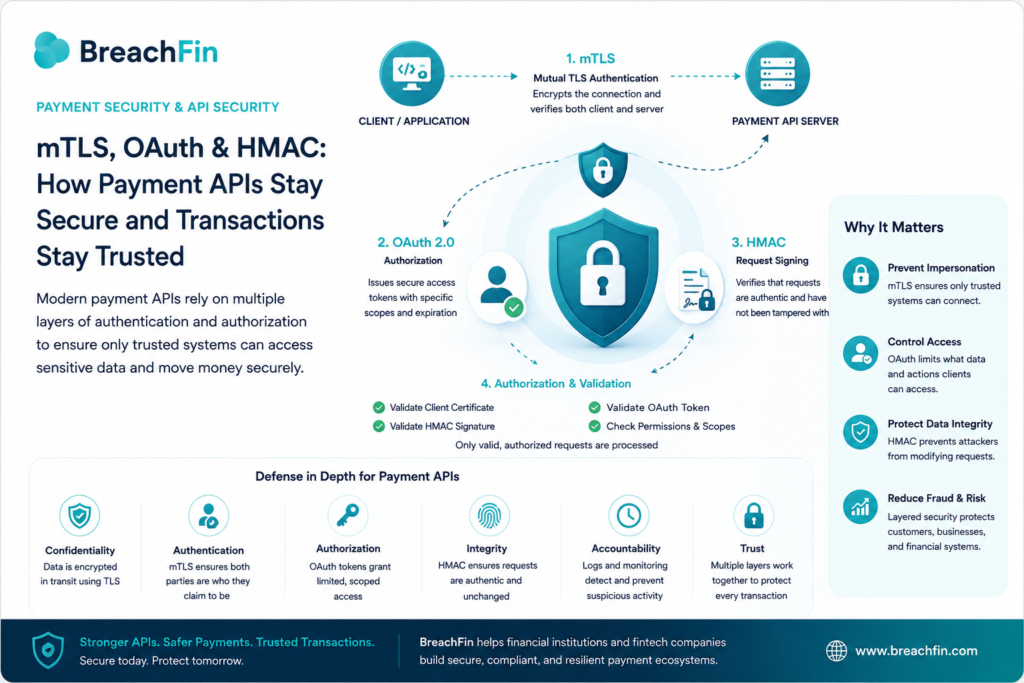
Technologies such as Mutual TLS (mTLS), OAuth 2.0, and HMAC request signing work together to ensure that only trusted systems can communicate and that every transaction remains authentic and tamper-proof.
Authentication vs Authorization
Before exploring these technologies, it’s important to understand two fundamental security concepts.
Authentication answers the question:
“Who are you?”
It verifies the identity of a user, application, or system.
Examples include:
- Client certificates
- API keys
- OAuth access tokens
- Passwords
- Biometrics
Authorization answers the question:
“What are you allowed to do?”
Even after identity is verified, the system still determines whether that identity has permission to perform a specific action.
Examples include:
- View account balances
- Initiate payments
- Approve wire transfers
- Access transaction history
- Generate reports
Authentication identifies you.
Authorization determines your permissions.
Layer 1: Mutual TLS (mTLS)
What is mTLS?
Most websites use HTTPS.
When you connect to a banking website, your browser verifies the bank’s certificate.
With Mutual TLS, the verification happens in both directions.
Both parties authenticate each other.
Client verifies Server.
Server verifies Client.
This creates a trusted machine-to-machine connection.
Why Payment APIs Use mTLS
Payment APIs frequently communicate between:
- Banks
- Fintech platforms
- Payment processors
- Open Banking providers
These systems don’t rely on usernames.
Instead, they authenticate using digital certificates issued by trusted Certificate Authorities.
If an attacker doesn’t possess a valid client certificate, the connection is rejected before the API request is even processed.
Benefits of mTLS
- Strong machine authentication
- Encrypted communication
- Protection against impersonation
- Reduced Man-in-the-Middle attacks
- Trusted server-to-server communication
mTLS has become a standard security control across modern financial institutions.
Layer 2: OAuth 2.0
What is OAuth?
OAuth 2.0 is an authorization framework.
It allows applications to access protected resources without sharing user passwords.
Instead of sending credentials every time, applications receive a temporary access token.
OAuth Flow
A simplified flow looks like this:
- User authenticates.
- Authorization server verifies identity.
- Access token is issued.
- Application includes the token in API requests.
- Resource server validates the token.
- Access is granted only if the token is valid.
Why Payment APIs Use OAuth
OAuth allows organizations to:
- Grant limited access
- Set token expiration
- Define API scopes
- Revoke compromised tokens
- Avoid sharing passwords
Layer 3: HMAC Authentication
What is HMAC?
HMAC stands for Hash-based Message Authentication Code.
Instead of simply authenticating the client, HMAC verifies that the API request has not been modified.
It ensures both:
- Integrity
- Authenticity
How HMAC Works
When an API request is created:
- Client generates a hash.
- The hash is created using:
- Secret key
- Request body
- Timestamp
- HTTP method
- URL
- Signature is sent with the request.
The server performs the same calculation.
If both signatures match:
The request has not been modified.
If they don’t match:
The request is rejected.
How These Technologies Work Together
Financial APIs rarely rely on a single security mechanism.
Instead, they combine multiple controls.
| Security Layer | Purpose |
|---|---|
| mTLS | Authenticates both client and server |
| OAuth 2.0 | Determines what the client is authorized to access |
| HMAC | Verifies the request has not been altered |
| TLS | Encrypts data in transit |
| API Gateway | Enforces policies, rate limits, and routing |
| Logging & Monitoring | Detects suspicious activity |
This layered approach follows the principle of Defense in Depth.
Additional Security Controls Used by Financial APIs
Beyond mTLS, OAuth, and HMAC, payment providers often implement:
- API gateways
- Rate limiting
- IP allowlisting
- Web Application Firewalls (WAF)
- Fraud detection engines
- Token expiration and refresh policies
- Certificate rotation
- Audit logging
- Continuous security monitoring
Together, these controls create a resilient security posture.
Best Practices for Secure Payment APIs
Organizations should:
- Use mTLS for all server-to-server communications.
- Implement OAuth 2.0 with narrowly scoped, short-lived access tokens.
- Sign sensitive requests with HMAC or an equivalent message authentication mechanism.
- Rotate certificates, secrets, and API keys regularly.
- Validate timestamps and use nonces to reduce replay attacks.
- Enforce least-privilege access for users, applications, and services.
- Monitor API traffic continuously for unusual behavior.
- Perform regular penetration testing and API security assessments.
Final Thoughts
Payment APIs form the backbone of today’s digital financial ecosystem, connecting banks, fintech platforms, payment processors, and merchants in real time. Because these APIs handle highly sensitive transactions, security must extend far beyond simple authentication.
By combining mTLS for mutual identity verification, OAuth 2.0 for secure authorization, and HMAC for message integrity, financial institutions build multiple layers of protection against impersonation, unauthorized access, and data tampering. When reinforced with encryption, monitoring, certificate management, and strong operational controls, these technologies enable secure, reliable, and trustworthy payment ecosystems.