Introduction
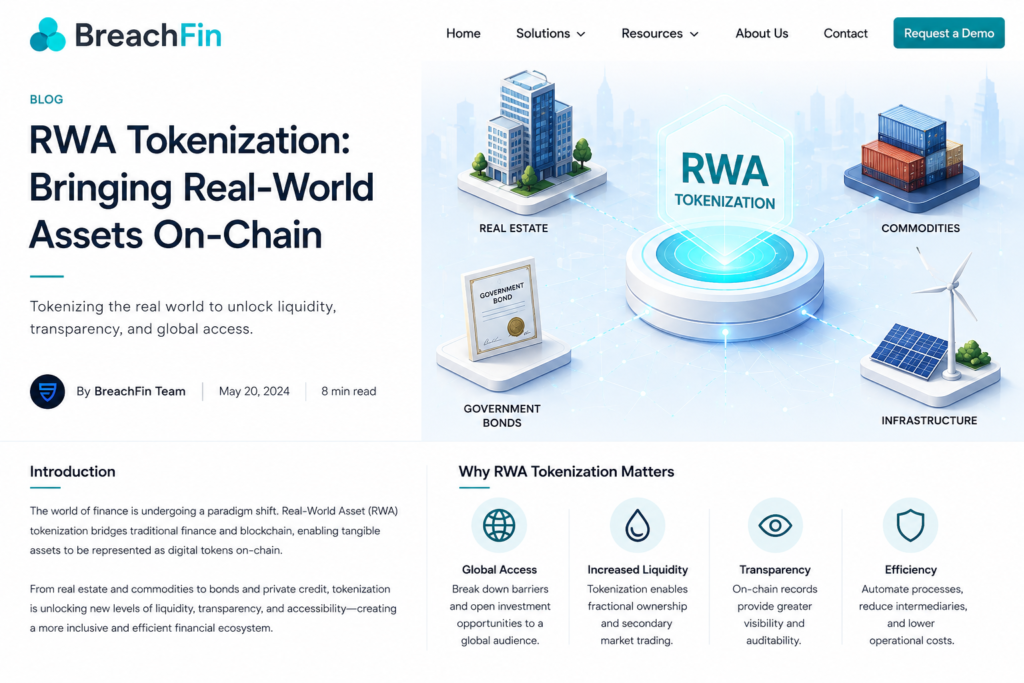
Blockchain technology has evolved far beyond cryptocurrencies. One of the fastest-growing innovations reshaping global finance is Real-World Asset (RWA) Tokenization—the process of converting ownership rights of physical or traditional financial assets into digital tokens on a blockchain.
From real estate and government bonds to private credit, invoices, commodities, and even fine art, tokenization is unlocking trillions of dollars in previously illiquid assets. Financial institutions, banks, asset managers, and fintech companies are increasingly adopting blockchain infrastructure to improve settlement speed, transparency, and global accessibility.
However, while tokenization creates enormous opportunities, it also introduces a completely new attack surface. Smart contracts, APIs, wallets, custodians, blockchain bridges, and digital identity systems all become critical components that must be secured.
At BreachFin, we believe that security should be built into tokenized financial ecosystems from day one—not added after deployment.
What is RWA Tokenization?
Real-World Asset tokenization is the process of creating a blockchain-based digital representation of ownership for a real asset.
Instead of relying solely on paper contracts or centralized databases, ownership is represented by blockchain tokens that can be securely transferred, tracked, and verified.
Examples include:
- Commercial real estate
- Residential property
- Government bonds
- Treasury bills
- Private credit funds
- Precious metals
- Carbon credits
- Supply chain invoices
- Renewable energy assets
- Intellectual property
Each token represents either:
- Full ownership
- Fractional ownership
- Revenue rights
- Debt obligations
- Future cash flows
Why Financial Institutions Are Adopting Tokenization
Increased Liquidity
Traditional assets such as commercial buildings may take months to sell.
Tokenization allows assets to be divided into thousands of smaller ownership units, enabling investors to buy or sell fractions instantly.
Faster Settlement
Traditional securities often settle in T+2 or longer.
Blockchain networks can reduce settlement from days to minutes while maintaining immutable records.
Global Accessibility
Investors no longer need to reside in a particular country.
Properly regulated tokenized assets can become globally accessible while still enforcing jurisdiction-specific compliance rules.
Transparency
Every transfer is recorded on-chain.
Auditors, regulators, and asset managers gain significantly improved visibility into ownership history.
Reduced Operational Costs
Automation through smart contracts reduces:
- Manual reconciliation
- Settlement costs
- Transfer agent expenses
- Administrative overhead
How RWA Tokenization Works
A simplified lifecycle includes:
Step 1 — Asset Verification
The issuer verifies legal ownership of the real-world asset.
Examples include:
- Property deeds
- Treasury ownership
- Bond issuance
- Gold reserves
Step 2 — Legal Structuring
Ownership rights are legally mapped to digital tokens through regulated entities.
Step 3 — Smart Contract Deployment
Developers create smart contracts that define:
- Ownership
- Transfers
- Compliance rules
- Dividend distribution
- Redemption mechanisms
Step 4 — Token Issuance
Blockchain tokens are minted representing ownership interests.
Step 5 — Investor Purchase
Qualified investors purchase tokens through regulated marketplaces.
Step 6 — Secondary Trading
Investors may trade tokens depending on applicable regulations and platform rules.
Industries Being Transformed
Real Estate
Fractional property ownership
Private Credit
Tokenized lending portfolios
Treasury Bills
Digital government securities
Commodities
Gold, silver, oil, and agricultural assets
Infrastructure
Energy and transportation projects
Carbon Markets
Tradable environmental credits
The Security Risks of RWA Platforms
Tokenizing assets introduces a blend of traditional financial risks and blockchain-specific vulnerabilities.
Smart Contract Vulnerabilities
A single flaw can result in:
- Unauthorized token minting
- Asset theft
- Frozen funds
- Governance manipulation
Rigorous audits, testing, and secure development practices are essential before deployment.
Wallet Compromise
Private keys control ownership.
If compromised:
- Assets can be stolen
- Ownership transferred irreversibly
- Investor funds permanently lost
Organizations should implement:
- Multi-signature wallets
- Hardware Security Modules (HSMs)
- Secure key rotation
- Role-based access controls
API Security
Modern tokenization platforms expose APIs for:
- Investor onboarding
- Trading
- Compliance checks
- Custody
- Settlement
Weak APIs can lead to:
- Broken authentication
- Account takeover
- Unauthorized transactions
- Data leakage
API authentication using OAuth 2.0, mutual TLS (mTLS), HMAC request signing, and rate limiting should be considered baseline controls.
Oracle Manipulation
Tokenized assets often rely on external data sources for:
- Asset prices
- Interest rates
- Exchange rates
- Reserve balances
Compromised oracles can trigger incorrect valuations or fraudulent transactions. Multiple independent data feeds and validation mechanisms help reduce this risk.
Identity & Compliance Risks
RWA platforms must balance decentralization with regulatory requirements.
Organizations need robust:
- Know Your Customer (KYC)
- Anti-Money Laundering (AML)
- Sanctions screening
- Identity verification
- Continuous monitoring
Blockchain Bridge Risks
Assets moving across multiple blockchains introduce additional complexity. Bridges have historically been a frequent target for attackers due to their large pools of locked value.
Best Practices for Secure Tokenization
Organizations building RWA platforms should:
- Conduct independent smart contract security audits
- Secure APIs with strong authentication and authorization
- Use hardware-backed key management
- Continuously monitor transactions for anomalies
- Enforce least-privilege access
- Perform penetration testing regularly
- Maintain continuous asset inventory
- Monitor third-party dependencies
- Log all administrative actions
- Implement real-time fraud detection
How BreachFin Helps Secure Tokenized Finance
As tokenization accelerates, security must evolve alongside innovation.
BreachFin helps fintechs, digital asset platforms, and financial institutions strengthen their security posture by focusing on the systems that power tokenized ecosystems.
Our approach includes:
- API Security Assessments
- Smart Contract Security Reviews (through trusted partners)
- Infrastructure Security Validation
- Cloud Security Assessments
- Continuous Threat Monitoring
- Third-Party Risk Assessments
- Secure Architecture Reviews
- Payment Platform Security Consulting
Our mission is to help organizations identify vulnerabilities before attackers do—enabling them to launch secure, compliant, and resilient digital financial services.
Looking Ahead
Analysts estimate that trillions of dollars in real-world assets could eventually be represented on blockchain networks. As adoption grows, success will depend not only on scalability and regulatory clarity but also on maintaining strong security controls across the entire ecosystem.
Organizations that prioritize secure architecture, continuous monitoring, and proactive risk management will be best positioned to realize the benefits of tokenization while protecting investors and maintaining trust.
Final Thoughts
RWA tokenization has the potential to reshape global finance by making traditionally illiquid assets more accessible, transparent, and efficient. Yet every new layer of digital infrastructure introduces new security considerations.
At BreachFin, we believe innovation and security should advance together. By embedding robust cybersecurity practices into tokenized platforms from the start, organizations can unlock the promise of digital assets while safeguarding the trust of investors, regulators, and customers.