Artificial intelligence is transforming how organizations operate, but it also introduces new risks that traditional cybersecurity frameworks were never designed to address. As AI adoption accelerates, organizations need a structured approach to manage security, privacy, and governance throughout the AI lifecycle.
The AI Risk Management Framework (AI RMF) provides guidance for identifying, assessing, and reducing AI-related risks while promoting trustworthy and responsible AI systems.
Why AI Risk Management Matters
AI models can introduce risks such as:
- Data privacy exposure
- Model bias and unfair outcomes
- Prompt injection attacks
- Sensitive information leakage
- Inaccurate or manipulated responses
- Regulatory and compliance challenges
Managing these risks requires more than technical controls—it requires governance across people, processes, and technology.
Core Functions of an AI Risk Management Framework
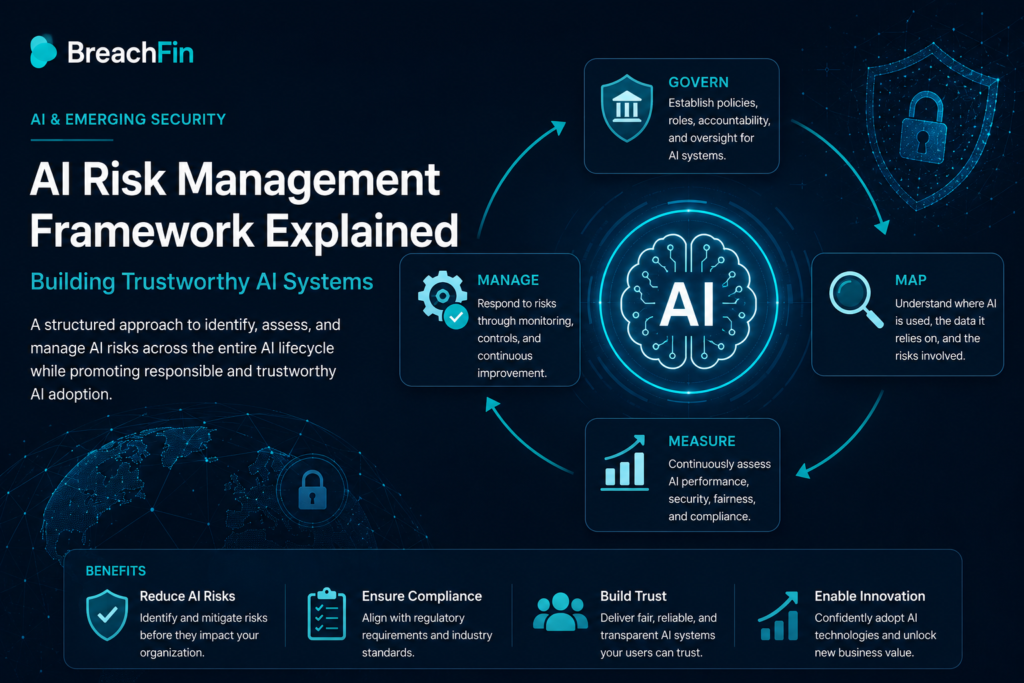
An effective AI risk management program focuses on four key areas:
Govern
Establish policies, roles, accountability, and oversight for AI systems.
Map
Understand where AI is used, the data it relies on, and the risks associated with each use case.
Measure
Continuously assess AI performance, security, fairness, and compliance using defined metrics.
Manage
Respond to identified risks through monitoring, policy enforcement, and continuous improvement.
Best Practices
Organizations should:
- Maintain an inventory of AI applications
- Classify AI systems based on risk
- Protect sensitive training data
- Monitor AI outputs for anomalies
- Review third-party AI providers
- Establish AI governance policies
- Continuously evaluate security and compliance
Final Thoughts
AI is becoming a core part of modern business operations, making effective risk management essential. Organizations that implement strong AI governance and continuously monitor AI systems will be better positioned to innovate securely while maintaining trust.
How BreachFin Helps
BreachFin helps organizations strengthen their security posture across emerging technologies by improving visibility into AI usage, cloud environments, integrations, and digital assets. Continuous monitoring enables security teams to identify risks early and support secure AI adoption.