Cybersecurity Is a Business Risk—Not Just an IT Problem
Cyberattacks continue to evolve in both sophistication and frequency. Financial institutions, fintech companies, payment providers, and digital asset platforms face increasing pressure to protect customer data, maintain operational resilience, and meet regulatory requirements.
Many organizations invest in security technologies but struggle to answer fundamental questions:
- Are we protecting our critical assets?
- Can we quickly detect cyber threats?
- Are we prepared to respond to an attack?
- How do we measure our cybersecurity maturity?
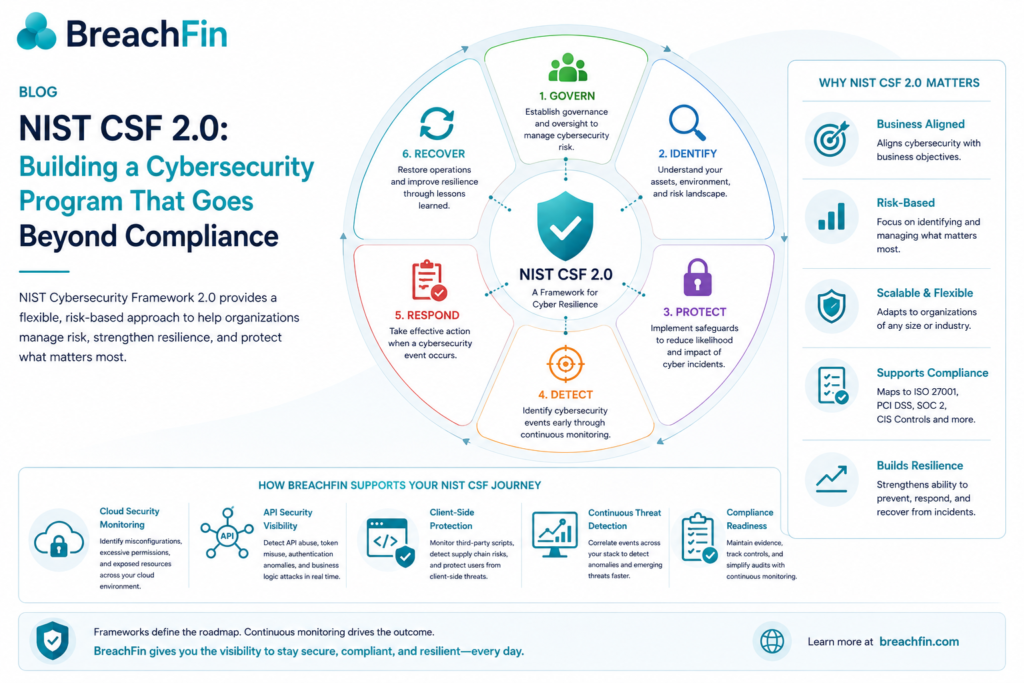
The NIST Cybersecurity Framework (CSF) 2.0 provides a structured approach to answering these questions and building a cybersecurity program that aligns security initiatives with business objectives.
What Is NIST CSF 2.0?
Developed by the National Institute of Standards and Technology (NIST), the Cybersecurity Framework is one of the world’s most widely adopted security frameworks.
Unlike regulations that prescribe mandatory controls, NIST CSF provides a flexible, risk-based approach that organizations of all sizes can adapt to their business needs.
Version 2.0 expands the framework by introducing a new core function—Govern—highlighting that cybersecurity is an enterprise-wide responsibility, not just an IT function.
The Six Core Functions
Govern
The new Govern function focuses on leadership and accountability.
Organizations should establish:
- Cybersecurity governance
- Risk management policies
- Security roles and responsibilities
- Vendor risk management
- Executive oversight
- Security metrics
Strong governance ensures cybersecurity aligns with business strategy.
Identify
Organizations must understand what they are protecting.
This includes:
- Hardware assets
- Software assets
- Cloud infrastructure
- APIs
- Data classification
- Business processes
- Third-party dependencies
Without an accurate inventory, organizations cannot effectively manage cyber risk.
Protect
Protection involves implementing safeguards that reduce the likelihood of successful attacks.
Examples include:
- Identity and Access Management (IAM)
- Multi-Factor Authentication (MFA)
- Encryption
- Secure software development
- Endpoint protection
- Security awareness training
- Backup strategies
These controls reduce the attack surface.
Detect
Organizations must rapidly identify suspicious activity before it becomes a major incident.
Detection capabilities include:
- Security monitoring
- SIEM platforms
- API monitoring
- Cloud security monitoring
- Client-side monitoring
- Threat intelligence
- Behavioral analytics
Early detection significantly reduces the impact of cyber incidents.
Respond
No organization can eliminate cyber risk entirely.
Incident response plans should define:
- Roles and responsibilities
- Communication procedures
- Containment strategies
- Investigation processes
- Regulatory notifications
- Recovery priorities
Prepared organizations recover faster.
Recover
Recovery focuses on restoring operations while improving resilience.
Organizations should:
- Restore systems securely
- Validate data integrity
- Conduct post-incident reviews
- Update security controls
- Improve response procedures
Every incident provides lessons that strengthen future defenses.
Why NIST CSF 2.0 Matters
NIST CSF is valuable because it is technology-neutral and scalable.
Whether an organization operates:
- On-premises
- Multi-cloud
- Hybrid cloud
- SaaS platforms
- Digital payment systems
- Blockchain infrastructure
The framework provides a consistent method for managing cybersecurity risk.
It also maps well to other standards including:
- ISO/IEC 27001
- PCI DSS
- SOC 2
- CIS Controls
- COBIT
Organizations can build one mature security program that supports multiple compliance requirements.
Continuous Monitoring Supports Every Function
The effectiveness of NIST CSF depends on visibility.
For example:
Govern
- Monitor policy compliance
- Track security KPIs
- Review third-party risk
Identify
- Discover cloud assets
- Inventory APIs
- Identify new applications
Protect
- Monitor IAM changes
- Detect configuration drift
- Validate security controls
Detect
- Monitor API behavior
- Identify client-side attacks
- Detect anomalous authentication
Respond
- Correlate alerts
- Prioritize incidents
- Accelerate investigations
Recover
- Validate restored systems
- Monitor recurring threats
- Improve resilience
Continuous monitoring transforms NIST CSF from a static framework into a living security program.
How BreachFin Supports NIST CSF
BreachFin provides continuous visibility across modern digital environments, helping organizations operationalize the Detect, Identify, Protect, and Govern functions of NIST CSF.
Cloud Security Monitoring
BreachFin continuously identifies:
- Cloud misconfigurations
- Excessive IAM permissions
- Configuration drift
- Infrastructure exposure
Helping organizations maintain a secure cloud environment.
API Security Visibility
Modern financial platforms rely heavily on APIs.
BreachFin continuously monitors:
- Authentication anomalies
- API abuse
- Token misuse
- Business logic attacks
- Unauthorized requests
Providing greater visibility into one of today’s most targeted attack surfaces.
Client-Side Security
Many attacks originate within the browser.
BreachFin continuously monitors:
- Third-party JavaScript
- Script integrity
- Supply chain risks
- Browser behavior
- Unauthorized code changes
Helping organizations reduce client-side risk.
Compliance Monitoring
Security frameworks require evidence.
BreachFin helps organizations maintain:
- Security event history
- Configuration changes
- API activity
- Authentication logs
- Continuous monitoring records
Supporting audit readiness while strengthening operational security.
Building Cyber Resilience
Cybersecurity frameworks are not designed to help organizations simply “pass audits.”
They exist to improve resilience.
The most successful organizations continuously:
- Identify new risks
- Strengthen controls
- Monitor changing environments
- Respond quickly
- Learn from incidents
Cybersecurity becomes a continuous business process rather than an annual compliance exercise.
Final Thoughts
NIST Cybersecurity Framework 2.0 provides organizations with a practical roadmap for managing cybersecurity risk in an increasingly complex digital world. By emphasizing governance, continuous monitoring, and resilience, it helps organizations move beyond reactive security toward a proactive, risk-based approach.
For financial institutions, fintech companies, and payment providers, adopting NIST CSF is not just about compliance—it is about protecting customer trust, ensuring business continuity, and enabling secure innovation.
At BreachFin, we believe that effective cybersecurity begins with visibility. Continuous monitoring across cloud infrastructure, APIs, client-side applications, authentication systems, and third-party integrations helps organizations turn framework requirements into measurable, real-world security outcomes.