Cybersecurity Starts with Strong Security Controls
Modern organizations operate in an increasingly complex threat landscape. Cloud adoption, hybrid workforces, APIs, artificial intelligence, and third-party integrations have expanded the attack surface, making cybersecurity more challenging than ever.
Organizations often ask:
- Which security controls should we implement?
- How do we manage cybersecurity risks consistently?
- How can we meet multiple compliance requirements without duplicating effort?
One of the most comprehensive answers comes from NIST Special Publication (SP) 800-53, a globally respected catalog of security and privacy controls designed to help organizations build resilient cybersecurity programs.
Although originally developed for U.S. federal information systems, NIST SP 800-53 has become a widely adopted framework across financial institutions, healthcare organizations, cloud providers, and private enterprises seeking a structured approach to managing cyber risk.
What Is NIST SP 800-53?
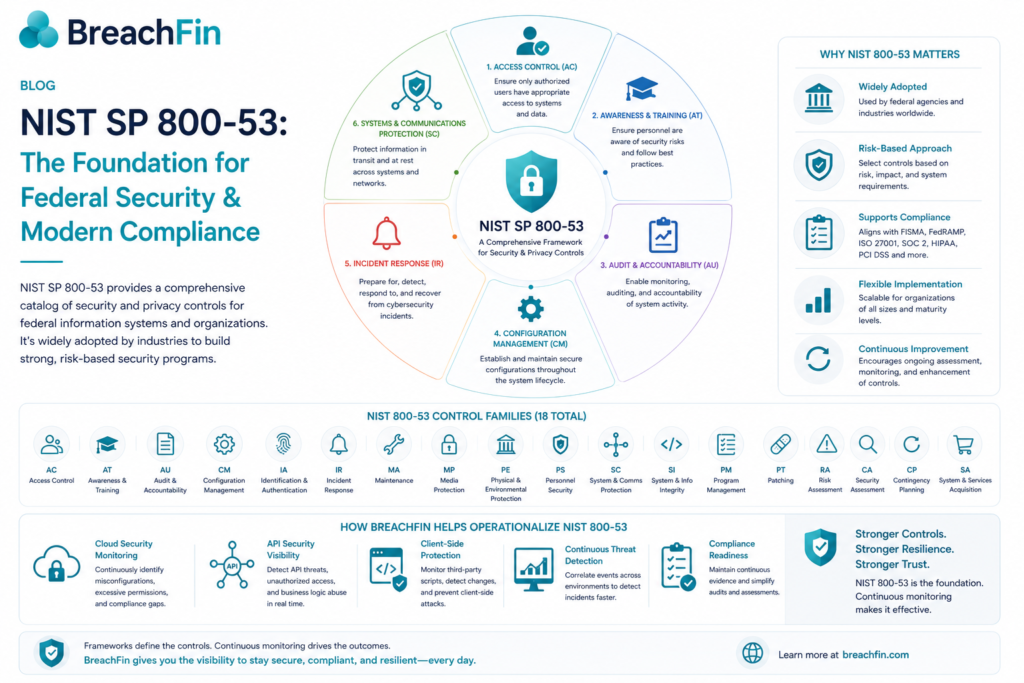
NIST SP 800-53 is a comprehensive catalog of security and privacy controls published by the National Institute of Standards and Technology (NIST).
Rather than focusing on a single compliance requirement, it provides organizations with a broad set of security controls that can be selected and tailored based on risk, business objectives, and regulatory obligations.
The framework supports organizations in protecting:
- Information systems
- Cloud infrastructure
- Applications
- Digital services
- Sensitive customer data
- Critical business operations
Its objective is simple:
Reduce cyber risk through standardized, risk-based security controls.
Why NIST SP 800-53 Matters
Cybersecurity is no longer just about preventing attacks.
Organizations must also:
- Protect customer information
- Maintain operational resilience
- Demonstrate regulatory compliance
- Manage third-party risks
- Respond effectively to incidents
- Continuously improve security posture
NIST SP 800-53 provides a structured roadmap to achieve these goals.
Key Control Families
NIST SP 800-53 contains 20 control families, each addressing a different aspect of cybersecurity and privacy.
Some of the most important include:
Access Control (AC)
Ensures only authorized users can access systems and data.
Key controls include:
- Role-Based Access Control (RBAC)
- Least Privilege
- Session Management
- Remote Access Controls
Audit and Accountability (AU)
Organizations must generate reliable audit trails.
This includes:
- Security logging
- Event monitoring
- Log protection
- Audit review
- Time synchronization
Comprehensive audit records improve both investigations and compliance.
Configuration Management (CM)
Configuration drift is one of today’s leading security risks.
Configuration management controls help organizations:
- Establish secure baselines
- Monitor changes
- Control software updates
- Prevent unauthorized modifications
Identification and Authentication (IA)
Identity remains one of the strongest security boundaries.
Controls focus on:
- Multi-Factor Authentication (MFA)
- Password policies
- Identity verification
- Credential management
- Service account security
Incident Response (IR)
Cyber incidents are inevitable.
Organizations should prepare by implementing:
- Incident response plans
- Communication procedures
- Investigation processes
- Recovery strategies
- Lessons learned
Prepared organizations recover faster.
Risk Assessment (RA)
Organizations should continuously evaluate:
- Emerging threats
- Vulnerabilities
- Business impact
- Likelihood of compromise
Risk assessments guide security investment decisions.
System and Communications Protection (SC)
Protecting data in transit and at rest is essential.
Controls include:
- Encryption
- Secure communications
- Network segmentation
- Boundary protection
- Cryptographic key management
Why Organizations Choose NIST SP 800-53
Unlike many compliance standards, NIST SP 800-53 is flexible.
Organizations can tailor controls based on:
- Industry
- Risk tolerance
- System criticality
- Regulatory requirements
- Organizational maturity
This makes it valuable for both public and private sectors.
Mapping to Other Frameworks
One of the strengths of NIST SP 800-53 is its ability to align with multiple cybersecurity frameworks.
Organizations commonly map its controls to:
- NIST Cybersecurity Framework (CSF)
- ISO/IEC 27001
- PCI DSS
- SOC 2
- HIPAA
- CIS Controls
- FedRAMP
Instead of maintaining separate security programs for every regulation, organizations can build a unified control framework that supports multiple compliance objectives.
Continuous Monitoring Is Essential
Implementing controls is only the beginning.
Cybersecurity environments evolve continuously.
New cloud resources are deployed.
Developers release new applications.
APIs change.
Third-party vendors update software.
Attackers develop new techniques.
Without continuous monitoring, organizations may not know whether their security controls remain effective.
How BreachFin Helps Operationalize NIST SP 800-53
BreachFin helps organizations move beyond documentation by providing continuous visibility into modern digital environments.
Cloud Security Monitoring
BreachFin continuously identifies:
- Cloud misconfigurations
- Excessive IAM permissions
- Configuration drift
- Infrastructure exposure
Helping organizations maintain secure cloud environments.
API Security Visibility
APIs power modern financial services.
BreachFin continuously monitors:
- Authentication anomalies
- API abuse
- Token misuse
- Business logic attacks
- Unauthorized requests
Supporting stronger application security.
Client-Side Security Monitoring
Modern applications increasingly depend on third-party JavaScript.
BreachFin continuously monitors:
- Third-party scripts
- Browser behavior
- Script integrity
- Supply chain attacks
- Unauthorized client-side changes
Reducing one of today’s fastest-growing attack surfaces.
Compliance Readiness
Preparing for audits often requires gathering evidence from multiple systems.
BreachFin provides visibility into:
- Security events
- Configuration changes
- Authentication activity
- API logs
- Continuous monitoring records
Helping organizations demonstrate ongoing security maturity while reducing manual effort.
Security Controls Are Only Effective If They Are Maintained
Many organizations implement strong controls during an audit or compliance initiative, only to see those controls weaken over time.
Configuration changes, infrastructure growth, software updates, and evolving threats can reduce the effectiveness of previously implemented safeguards.
Continuous validation ensures that security controls remain aligned with organizational objectives and changing business environments.
Final Thoughts
NIST SP 800-53 is more than a compliance document—it is a comprehensive framework for building resilient cybersecurity programs. By organizing security into well-defined control families, it helps organizations establish governance, strengthen technical safeguards, improve operational resilience, and manage cyber risk consistently.
However, security controls are not static. They require continuous monitoring, regular validation, and ongoing improvement to remain effective in today’s rapidly evolving threat landscape.
At BreachFin, we believe that cybersecurity frameworks become truly valuable when paired with continuous visibility. By monitoring cloud infrastructure, APIs, client-side applications, authentication systems, and third-party integrations, organizations can transform NIST SP 800-53 from a checklist into a living cybersecurity program that protects critical business operations every day.