Compliance Should Strengthen Security—Not Replace It
Many organizations begin their cybersecurity journey with a simple goal:
“We need to become compliant.”
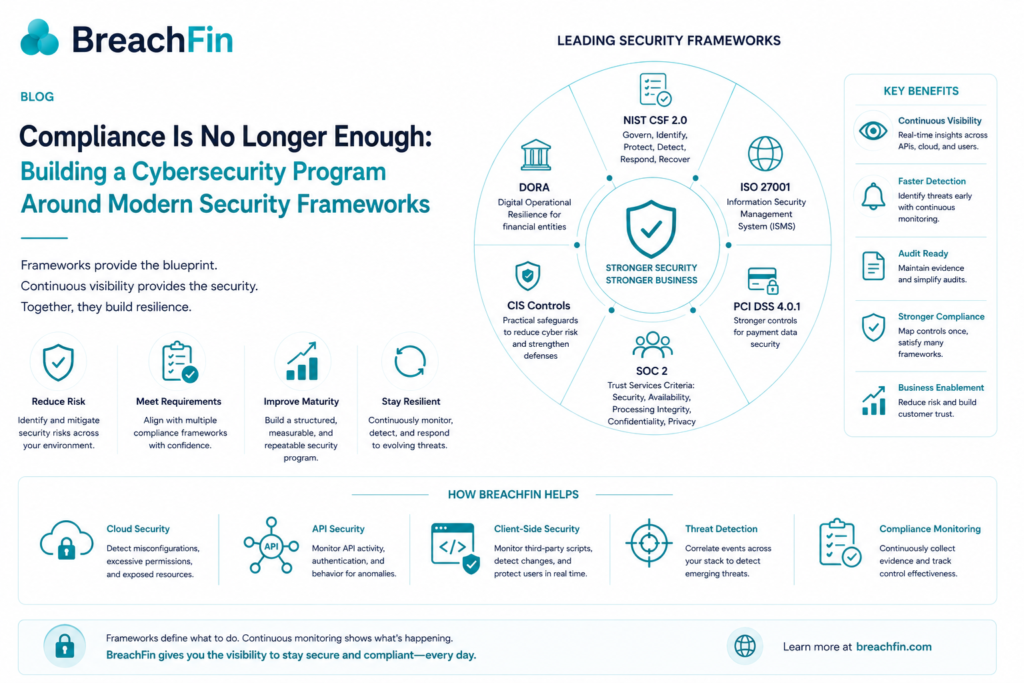
Whether it’s PCI DSS, ISO 27001, SOC 2, NIST CSF, DORA, or CIS Controls, compliance frameworks provide valuable guidance for protecting information systems and managing cyber risk.
However, one misconception continues to exist across many organizations:
Being compliant does not automatically mean being secure.
Attackers don’t care whether an organization passed an audit six months ago. They look for misconfigurations, exposed APIs, compromised credentials, vulnerable applications, and weak operational controls.
The strongest cybersecurity programs treat compliance as a foundation—not the finish line.
Why Security Frameworks Matter
Cybersecurity frameworks provide organizations with structured guidance for managing cyber risk consistently.
Rather than creating security controls from scratch, organizations can leverage well-established frameworks that have been developed through years of industry collaboration.
These frameworks help organizations:
- Establish governance
- Identify cyber risks
- Implement security controls
- Improve operational resilience
- Demonstrate regulatory compliance
- Measure cybersecurity maturity
The result is a repeatable and measurable security program.
The Most Common Security Frameworks
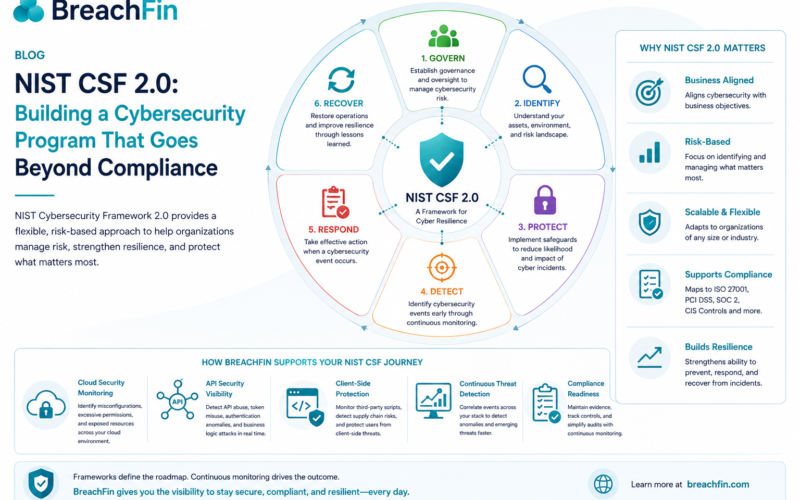
NIST Cybersecurity Framework (CSF) 2.0
NIST CSF 2.0 remains one of the most widely adopted cybersecurity frameworks globally. It is built around six core functions:
- Govern
- Identify
- Protect
- Detect
- Respond
- Recover
The addition of the Govern function reinforces that cybersecurity is a business governance issue—not solely an IT responsibility.
ISO/IEC 27001
ISO 27001 provides a framework for building and maintaining an Information Security Management System (ISMS).
It emphasizes:
- Risk management
- Policies and procedures
- Asset management
- Access control
- Continuous improvement
Many multinational organizations pursue ISO 27001 certification to demonstrate a mature security management program.
PCI DSS 4.0.1
Organizations processing payment card information must comply with PCI DSS.
The latest version places increased emphasis on:
- Continuous monitoring
- Authentication
- Client-side security
- Security testing
- Customized security approaches
Rather than annual compliance exercises, PCI DSS encourages ongoing security validation.
SOC 2
SOC 2 focuses on protecting customer data through the Trust Services Criteria:
- Security
- Availability
- Processing Integrity
- Confidentiality
- Privacy
Many SaaS providers use SOC 2 to demonstrate operational maturity to enterprise customers.
CIS Controls
The CIS Critical Security Controls provide practical technical safeguards that organizations can implement regardless of size.
These controls prioritize actions that reduce the most common cyber risks and are often used alongside larger frameworks.
DORA
For financial institutions operating in or serving the European market, the Digital Operational Resilience Act (DORA) shifts the focus beyond compliance toward operational resilience.
DORA emphasizes:
- ICT risk management
- Incident reporting
- Digital resilience testing
- Third-party risk management
- Information sharing
Its objective is to ensure financial organizations can continue operating even during significant cyber incidents.
The Challenge of Multiple Frameworks
Many organizations must comply with more than one framework simultaneously.
For example, a fintech company may need to address:
- PCI DSS
- SOC 2
- ISO 27001
- NIST CSF
- GDPR
- DORA
At first glance, this appears overwhelming.
Fortunately, these frameworks often overlap.
Controls such as:
- Multi-factor authentication
- Asset inventory
- Logging
- Vulnerability management
- Incident response
- Access control
appear across multiple standards.
Organizations that build security around common controls can satisfy multiple compliance requirements with significantly less duplication.
Compliance Is Continuous
Cybersecurity environments change every day.
New applications are deployed.
Cloud resources are provisioned.
Developers release new code.
Third-party vendors update services.
Attackers evolve continuously.
Compliance should therefore be viewed as an ongoing process—not an annual project.
Organizations should continuously monitor:
- Cloud infrastructure
- APIs
- User access
- Configuration changes
- Third-party integrations
- Client-side applications
- Security events
Continuous visibility supports both stronger security and easier audits.
How BreachFin Supports Compliance
Compliance frameworks define what organizations should achieve.
BreachFin helps organizations understand how their environment is changing in real time.
Continuous Cloud Monitoring
BreachFin identifies:
- Cloud misconfigurations
- Excessive permissions
- Configuration drift
- Infrastructure exposure
Helping organizations maintain a stronger cloud security posture.
API Security Visibility
APIs power modern financial services.
BreachFin continuously monitors:
- Authentication anomalies
- Token misuse
- Suspicious API behavior
- Unauthorized requests
- Business logic abuse
Supporting secure digital services.
Client-Side Security Monitoring
Modern compliance increasingly emphasizes browser security.
BreachFin helps organizations monitor:
- Third-party JavaScript
- Script integrity
- Browser behavior
- Supply chain risks
- Unauthorized code changes
Providing visibility into one of today’s fastest-growing attack surfaces.
Continuous Evidence Collection
Preparing for audits often requires collecting security evidence across multiple systems.
BreachFin helps organizations maintain visibility into:
- Security events
- Configuration changes
- API activity
- Authentication logs
- Continuous monitoring records
This reduces manual effort while improving operational awareness.
Security Beyond the Audit
Passing an audit is important.
Remaining secure afterward is even more important.
The most resilient organizations view compliance as:
- A governance framework
- A security roadmap
- A continuous improvement process
- A business enabler
Instead of asking:
“Are we compliant?”
Security leaders increasingly ask:
“Are we resilient against today’s threats?”
That shift in mindset makes all the difference.
Final Thoughts
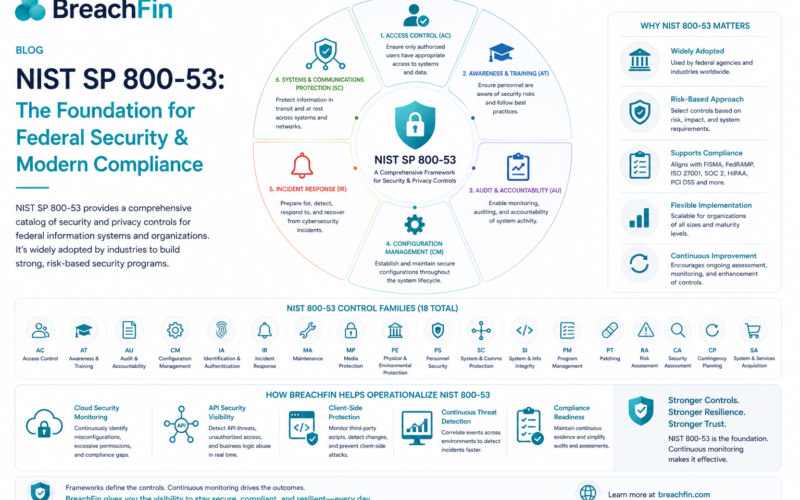
Cybersecurity frameworks such as NIST CSF 2.0, ISO 27001, PCI DSS, SOC 2, CIS Controls, and DORA provide organizations with proven guidance for managing cyber risk. They establish the governance, policies, and technical controls needed to build a mature security program.
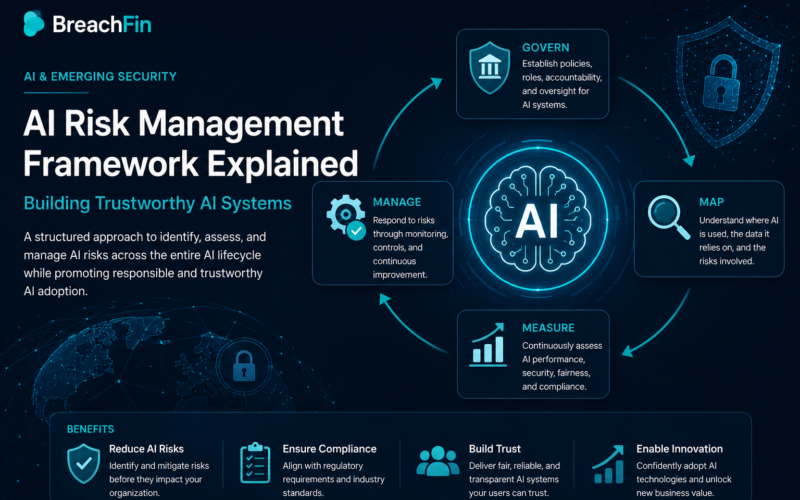
However, frameworks alone cannot stop cyberattacks. Real security comes from continuously validating that controls remain effective as infrastructure, applications, and threats evolve.
At BreachFin, we believe compliance and continuous monitoring should work together. By providing ongoing visibility across APIs, cloud infrastructure, client-side applications, authentication systems, and third-party dependencies, organizations can move beyond checkbox compliance toward true cyber resilience.