APIs Are the Backbone of Modern Financial Services
Every digital payment, mobile banking transaction, crypto wallet transfer, and fintech integration depends on APIs. They enable applications to communicate securely, exchange financial data, and deliver real-time services that customers rely on every day.
As financial institutions continue their digital transformation, APIs have become one of their most valuable assets—and one of the most attractive targets for cybercriminals.
According to recent industry reports, API-related attacks continue to increase as organizations expose more services to customers, partners, and third-party platforms. Attackers recognize that compromising an API often provides direct access to sensitive customer information, payment systems, and business-critical operations.
The message is simple:
If your APIs aren’t secure, neither is your business.
Why APIs Are Increasingly Targeted
Modern financial ecosystems consist of interconnected services.
A single customer transaction may involve APIs for:
- Mobile banking
- Authentication
- Payment processing
- Fraud detection
- Digital wallets
- Customer identity
- Open Banking
- Third-party fintech integrations
Every new API expands the organization’s attack surface.
Without continuous monitoring, organizations may not realize an API has been compromised until customer data or financial assets have already been affected.
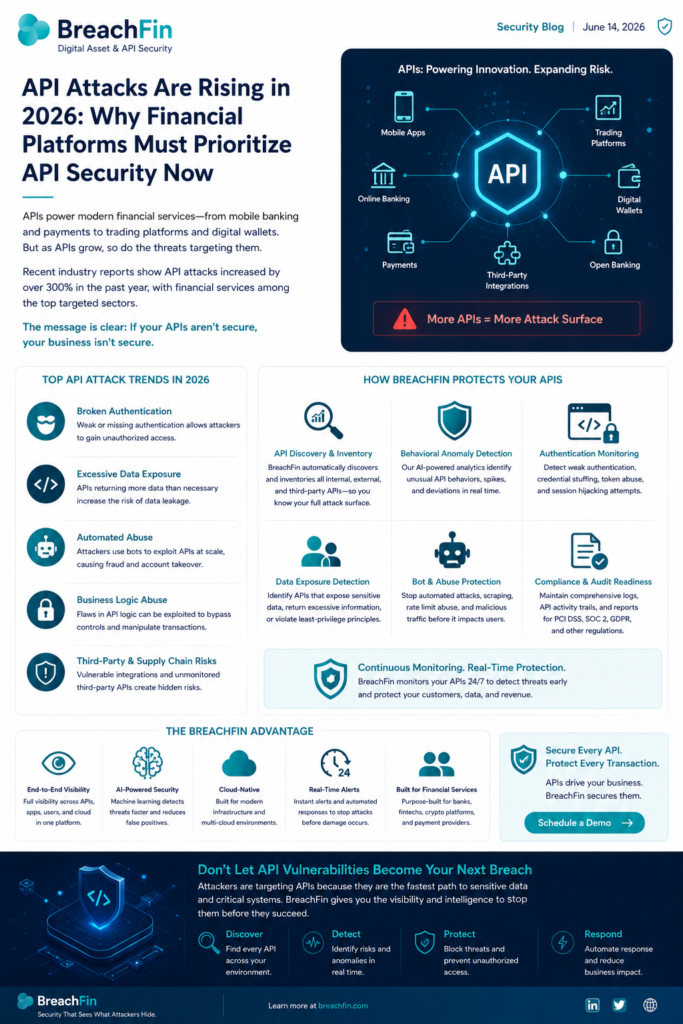
Common API Security Risks
Broken Authentication
Weak authentication mechanisms allow attackers to impersonate legitimate users.
Common causes include:
- Stolen access tokens
- Weak passwords
- Credential stuffing
- Missing Multi-Factor Authentication (MFA)
- Session hijacking
Strong authentication is the first line of defense.
Excessive Data Exposure
Many APIs return more information than applications actually require.
If sensitive fields are unintentionally exposed, attackers may gain access to:
- Customer records
- Payment information
- Internal identifiers
- Account details
- Personal data
Organizations should follow the principle of least data exposure.
Automated Bot Attacks
Attackers increasingly use automation to exploit APIs.
Examples include:
- Credential stuffing
- Account takeover attempts
- Excessive login requests
- API scraping
- Fake account creation
- Fraudulent payment requests
Without behavioral monitoring, automated attacks can appear similar to legitimate traffic.
Business Logic Abuse
Not every attack exploits a software vulnerability.
Some attackers manipulate legitimate application workflows to perform unauthorized actions, bypass business rules, or abuse financial processes.
These attacks are often difficult to detect using traditional security tools alone.
Third-Party API Risks
Modern applications integrate with:
- Payment providers
- Identity services
- Analytics platforms
- Customer support tools
- Cloud services
A compromised third-party API or integration can expose sensitive business operations.
Continuous monitoring should extend beyond internally developed APIs.
How BreachFin Protects Your APIs
Traditional API security focuses on blocking known threats.
BreachFin takes a different approach by providing continuous visibility across your API ecosystem, helping organizations detect abnormal behavior before it becomes a security incident.
API Discovery & Inventory
Organizations cannot secure APIs they don’t know exist.
BreachFin continuously discovers and inventories:
- Internal APIs
- External APIs
- Partner integrations
- Third-party services
This provides complete visibility into the organization’s API landscape.
Behavioral Anomaly Detection
Not every attack has a known signature.
BreachFin analyzes API behavior to identify:
- Sudden traffic spikes
- Abnormal request patterns
- Unusual authentication behavior
- Geographic anomalies
- High-risk user activity
Behavioral analytics help uncover emerging threats that traditional rule-based systems may miss.
Authentication Monitoring
Authentication events provide valuable indicators of compromise.
BreachFin continuously monitors for:
- Failed login attempts
- Token abuse
- Credential stuffing
- Session anomalies
- Unauthorized authentication flows
Early detection helps reduce the risk of account takeover.
Sensitive Data Exposure Detection
BreachFin analyzes API responses to identify:
- Sensitive data exposure
- Excessive information disclosure
- Misconfigured endpoints
- Unexpected response changes
This helps organizations reduce unnecessary data leakage.
Bot & Abuse Protection
Automated attacks can overwhelm APIs within minutes.
BreachFin helps identify:
- High-frequency requests
- Automated scanning
- Suspicious user agents
- Traffic anomalies
- API abuse patterns
Security teams gain visibility before attacks impact customers.
Compliance & Audit Readiness
API security also supports regulatory compliance.
BreachFin provides visibility into:
- API activity logs
- Security events
- Authentication history
- Access monitoring
- Audit reporting
Helping organizations strengthen readiness for PCI DSS, SOC 2, ISO 27001, and other compliance frameworks.
Why Continuous Monitoring Matters
APIs change constantly.
New endpoints are deployed.
Third-party integrations evolve.
Applications scale.
Attackers adapt.
Static security assessments performed once or twice a year are no longer sufficient.
Continuous monitoring enables organizations to:
- Detect new APIs
- Identify abnormal behavior
- Investigate incidents faster
- Reduce operational risk
- Protect customer data
- Improve security visibility
The BreachFin Advantage
BreachFin provides continuous security monitoring across the entire digital ecosystem.
Organizations gain visibility into:
- APIs
- Cloud infrastructure
- Client-side applications
- Authentication activity
- Third-party integrations
- Security events
Instead of relying solely on perimeter defenses, BreachFin helps security teams identify threats as they emerge—before they become breaches.
Final Thoughts
APIs have become the foundation of modern financial services, powering everything from mobile banking and payment processing to digital wallets and Open Banking. As organizations expose more APIs to customers and partners, the opportunities for attackers continue to grow.
Protecting APIs requires more than traditional security controls. Organizations need continuous visibility into API behavior, authentication activity, data exposure, and emerging attack patterns.
BreachFin helps financial institutions and fintech platforms stay ahead of evolving threats by continuously monitoring APIs, identifying abnormal behavior, and providing actionable insights that strengthen security before attackers can exploit vulnerabilities.