The Invisible Technology Behind Real-Time Applications
Every second, millions of financial transactions, payment notifications, fraud alerts, order confirmations, and mobile app updates are exchanged across the internet.
Behind many of these real-time systems is a technology called a message queue.
Message queues allow applications to communicate reliably without waiting for each other to finish processing. They make modern systems faster, more scalable, and more resilient.
One of the most popular message queue platforms today is Apache Kafka, used by banks, fintech companies, payment processors, retailers, and cloud-native applications worldwide.
However, because message queues often carry sensitive business data, securing them is just as important as securing APIs, databases, and cloud infrastructure.
What Is a Message Queue?
A message queue is a communication mechanism that allows applications to exchange information asynchronously.
Instead of sending requests directly to another application and waiting for a response, an application places a message into a queue.
Another application retrieves and processes that message when it is ready.
Think of it like sending a package through a courier service.
- The sender drops off the package.
- The courier safely stores and transports it.
- The recipient collects it when available.
The sender and receiver do not need to communicate at the same time.
Why Do Organizations Use Message Queues?
Modern applications often consist of dozens or hundreds of independent services.
For example, an online payment may trigger multiple actions simultaneously:
- Validate customer identity
- Check fraud rules
- Process payment
- Update account balances
- Send SMS confirmation
- Send email receipt
- Update transaction history
- Generate audit logs
Instead of performing these tasks one after another, a message queue allows each service to process its work independently, improving speed and reliability.
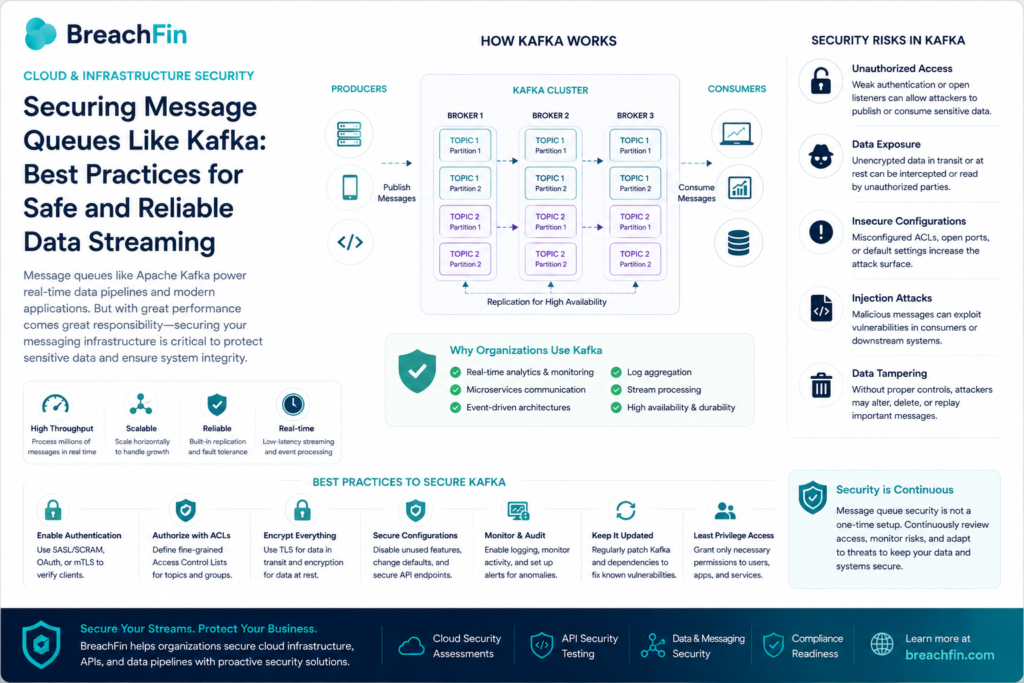
How Kafka Works
Apache Kafka is a distributed event streaming platform designed to handle massive volumes of real-time data.
Kafka revolves around four primary components.
Producers
A producer is an application that publishes messages.
Examples include:
- Payment gateways
- Banking applications
- Mobile apps
- Fraud detection systems
- IoT devices
The producer sends messages to Kafka.
Topics
Messages are organized into topics.
A topic acts like a category.
Examples include:
- Payments
- Transactions
- User Logins
- Fraud Alerts
- Notifications
- Audit Events
Applications subscribe only to the topics they need.
Brokers
Kafka stores messages on servers called brokers.
Multiple brokers work together as a Kafka cluster.
This provides:
- High availability
- Fault tolerance
- Horizontal scalability
If one broker fails, others continue processing messages.
Consumers
Consumers retrieve messages from Kafka.
Examples include:
- Reporting systems
- Fraud engines
- Notification services
- Payment processors
- Analytics platforms
Multiple consumers can process the same event independently.
A Real-World Payment Example
Imagine a customer transfers $500 through a banking application.
Instead of sending one request to every system, the application publishes a Payment Completed event to Kafka.
Several services subscribe to that event:
Fraud Service
- Performs fraud analysis
Ledger Service
- Updates account balances
Notification Service
- Sends confirmation emails and SMS messages
Reporting Service
- Updates dashboards
Compliance Service
- Stores audit logs
Each service processes the event independently without slowing down the others.
Why Kafka Is So Popular
Organizations choose Kafka because it offers:
High Throughput
Kafka can process millions of messages every second.
Scalability
Additional brokers can be added as workloads increase.
Reliability
Data is replicated across multiple brokers.
If one server fails, messages remain available.
Low Latency
Messages are delivered within milliseconds.
This makes Kafka ideal for:
- Real-time payments
- Fraud detection
- Market data
- Financial transactions
Event Streaming
Kafka allows multiple applications to consume the same event simultaneously.
One payment event may trigger dozens of downstream business processes.
Security Risks in Message Queues
Because Kafka often carries sensitive information, attackers frequently target messaging systems.
Unauthorized Access
If Kafka brokers allow anonymous connections, attackers may:
- Read confidential messages
- Publish fake events
- Delete topics
- Disrupt applications
Authentication should always be required.
Data Exposure
Messages may contain:
- Customer information
- Payment details
- Account numbers
- Authentication tokens
Without encryption, attackers may intercept sensitive data while it travels across the network.
Insecure Configurations
Default Kafka installations may expose unnecessary services.
Common mistakes include:
- Open ports
- Weak ACLs
- Anonymous users
- Disabled encryption
- Excessive administrative permissions
Secure configuration is critical before deployment.
Message Tampering
Attackers may attempt to:
- Modify messages
- Replay old events
- Delete important transactions
- Publish fraudulent messages
Integrity validation and access controls help prevent these attacks.
Denial-of-Service (DoS)
Large volumes of malicious messages can overwhelm brokers and consumers.
Rate limiting, monitoring, and capacity planning help maintain system availability.
Security Best Practices for Kafka
Enable Strong Authentication
Require authenticated clients before allowing access.
Common authentication methods include:
- SASL/SCRAM
- OAuth 2.0
- Mutual TLS (mTLS)
- Kerberos
Never allow anonymous production access.
Encrypt Data in Transit
Use TLS to encrypt communications between:
- Producers
- Brokers
- Consumers
Encryption prevents attackers from intercepting sensitive messages.
Encrypt Data at Rest
Messages stored on Kafka brokers should also be encrypted.
This protects data if storage systems are compromised.
Implement Access Control Lists (ACLs)
Not every application should access every topic.
Use ACLs to define:
- Who can publish
- Who can consume
- Who can administer clusters
Apply the principle of least privilege.
Secure Topic Permissions
Sensitive topics containing:
- Payments
- Personally Identifiable Information (PII)
- Authentication events
- Audit logs
should have stricter access controls than general application logs.
Monitor Kafka Continuously
Organizations should monitor:
- Authentication failures
- Broker health
- Consumer lag
- Unusual message volumes
- Unauthorized topic creation
- Configuration changes
Continuous monitoring enables rapid detection of suspicious activity.
Rotate Credentials
Regularly rotate:
- API keys
- Certificates
- Service account credentials
- OAuth tokens
Long-lived credentials increase organizational risk.
Patch Regularly
Keep Kafka brokers and dependencies updated to protect against known vulnerabilities.
Timely patching reduces exposure to publicly disclosed security issues.
Kafka in Financial Services
Banks, payment processors, and fintech companies use Kafka for:
- Real-time payment processing
- Fraud detection
- Transaction monitoring
- Open Banking APIs
- Digital wallet notifications
- Regulatory reporting
- Audit logging
- Customer notifications
Because these systems process highly sensitive financial information, strong security controls are essential for maintaining trust, regulatory compliance, and operational resilience.
Building a Secure Messaging Architecture
A secure Kafka deployment should include:
- Strong client authentication
- TLS encryption
- Role-based access control
- Topic-level permissions
- Secrets management
- Continuous monitoring
- Audit logging
- Secure configuration management
- Regular vulnerability assessments
- Disaster recovery planning
Message security should be treated as a core part of an organization’s cybersecurity strategy—not an afterthought.
Final Thoughts
Message queues such as Apache Kafka have become the backbone of modern distributed applications, enabling organizations to process millions of real-time events quickly and reliably. From financial transactions and fraud detection to customer notifications and analytics, Kafka helps businesses build scalable and resilient systems.
However, with great performance comes greater responsibility. Sensitive messages moving through Kafka must be protected with strong authentication, encryption, least-privilege access controls, continuous monitoring, and secure configuration practices. Organizations that invest in messaging security are better positioned to protect customer data, maintain compliance, and ensure uninterrupted business operations.