APIs Are Evolving—So Are Their Security Challenges
Modern applications demand fast, flexible, and efficient access to data. Whether it’s a mobile banking app, fintech platform, e-commerce website, or customer portal, users expect applications to retrieve exactly the information they need with minimal delay.
Traditional REST APIs have powered applications for years, but many organizations are now adopting GraphQL to improve performance and simplify development.
While GraphQL offers tremendous flexibility, it also introduces unique security challenges that organizations must understand before exposing GraphQL endpoints to the internet.
For financial institutions and fintech companies, securing GraphQL APIs is just as important as securing payment gateways or cloud infrastructure.
What Is GraphQL?
GraphQL is an API query language developed by Facebook (now Meta) that allows clients to request exactly the data they need from a server.
Instead of accessing multiple REST endpoints, clients send a single query describing the required data.
The server returns only the requested fields.
REST vs GraphQL
Traditional REST
To build a customer dashboard, an application may call:
/customers/123/accounts/123/transactions/cards/notifications
Multiple requests are required.
GraphQL
With GraphQL, the application sends one query requesting:
- Customer profile
- Account balances
- Recent transactions
- Active cards
- Notifications
The server returns everything in a single response.
This reduces network traffic and improves application performance.
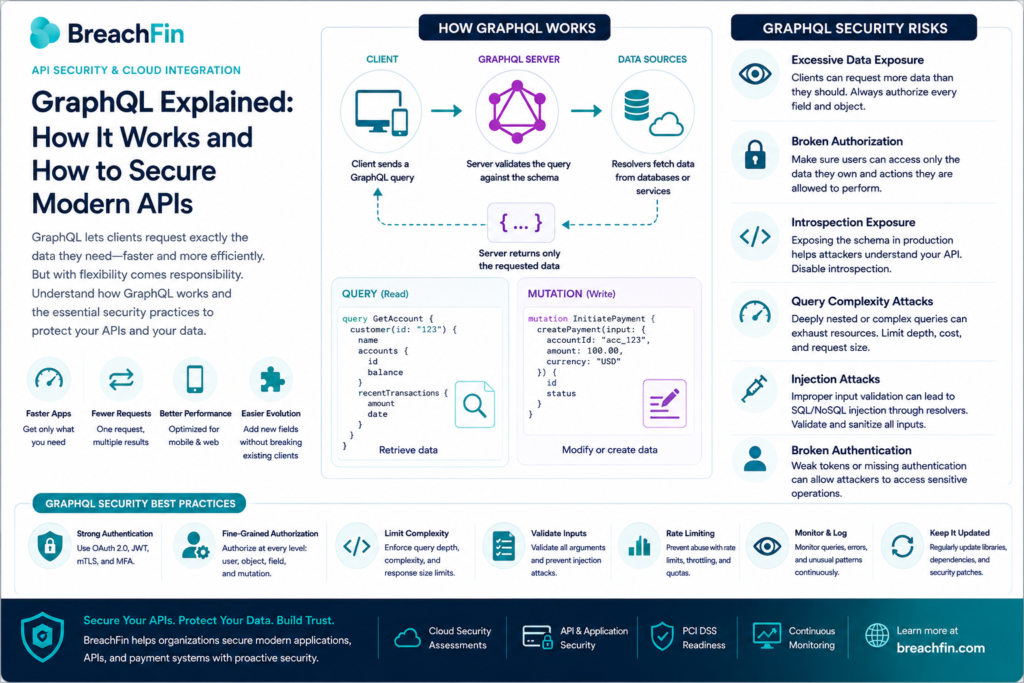
How GraphQL Works
GraphQL consists of several key components.
Schema
The schema defines the available data and operations.
It acts as a contract between the client and the server.
Query
Queries retrieve information.
Example requests include:
- Customer information
- Account balances
- Transaction history
Mutation
Mutations modify data.
Examples include:
- Initiate a payment
- Update customer details
- Change passwords
- Create new accounts
Resolver
Resolvers contain the application logic that retrieves data from databases or backend services.
They determine how each requested field is populated.
Why Developers Love GraphQL
GraphQL provides several advantages.
Faster Applications
Only requested data is returned.
Applications avoid downloading unnecessary information.
Fewer API Calls
A single request can replace multiple REST API calls.
Better Mobile Performance
Reduced bandwidth improves application responsiveness on mobile networks.
Easier API Evolution
New fields can be added without breaking existing clients.
This allows APIs to evolve while maintaining backward compatibility.
Security Challenges in GraphQL
The same flexibility that makes GraphQL powerful also creates security risks.
Excessive Data Exposure
Clients can request many fields within a single query.
Without proper authorization, attackers may retrieve sensitive information such as:
- Email addresses
- Internal identifiers
- Administrative flags
- Financial records
- Personal information
Every requested field should be validated before being returned.
Broken Authorization
Authentication identifies the user.
Authorization determines what that user can access.
A GraphQL API should verify permissions for every object and every field—not just the initial request.
For example, an authenticated customer should never be able to retrieve another customer’s account information simply by changing an identifier.
Introspection Exposure
GraphQL supports introspection, allowing clients to discover the API schema automatically.
While useful for developers, exposing introspection in production can reveal:
- Available queries
- Hidden mutations
- Object relationships
- Internal data structures
Production systems should restrict or disable introspection where appropriate.
Query Complexity Attacks
Attackers can submit extremely large or deeply nested queries.
These requests may consume excessive CPU and memory, leading to denial-of-service (DoS) conditions.
Organizations should enforce:
- Maximum query depth
- Query complexity limits
- Request size restrictions
Broken Authentication
GraphQL relies on the same authentication methods as other APIs.
Common approaches include:
- OAuth 2.0
- OpenID Connect
- JWT tokens
- Mutual TLS (mTLS)
Authentication should always occur before processing queries.
Injection Attacks
Resolvers frequently interact with databases.
Improper input validation may allow:
- SQL Injection
- NoSQL Injection
- Command Injection
Developers should validate and sanitize all user input before processing.
GraphQL Security Best Practices
Enforce Strong Authentication
Use modern authentication mechanisms such as:
- OAuth 2.0
- JWT
- mTLS
- Multi-Factor Authentication (MFA)
Validate Authorization at Every Level
Authorization should be enforced:
- Per user
- Per object
- Per field
- Per mutation
Never assume authenticated users can access all data.
Disable Introspection in Production
Limit schema discovery to trusted development environments whenever possible.
Limit Query Complexity
Implement controls for:
- Maximum query depth
- Maximum response size
- Execution time
- Rate limiting
These controls help prevent resource exhaustion attacks.
Validate All Inputs
Every GraphQL argument should be validated before being processed.
Reject unexpected or malformed input early.
Log and Monitor GraphQL Activity
Continuous monitoring should identify:
- Failed authentication attempts
- Unusual query patterns
- Large nested queries
- Excessive mutations
- Geographic anomalies
- High request volumes
Visibility enables rapid incident response.
GraphQL in Financial Services
Many financial organizations are adopting GraphQL for:
- Mobile banking applications
- Digital wallets
- Investment platforms
- Customer portals
- Payment dashboards
- Fintech integrations
Because these APIs expose highly sensitive financial information, security must be integrated into every stage of development.
Combining GraphQL with strong authentication, least-privilege authorization, continuous monitoring, and secure coding practices helps protect customer data while maintaining performance.
Building Secure GraphQL APIs
A secure GraphQL implementation should include:
- Strong authentication (OAuth 2.0, JWT, or mTLS)
- Fine-grained authorization
- Query depth and complexity limits
- Input validation
- Rate limiting
- API gateway protection
- Continuous monitoring
- Regular penetration testing
- Secure software development lifecycle (SSDLC)
Security should be built into the API from the beginning—not added after deployment.
Final Thoughts
GraphQL has transformed how modern applications communicate by giving clients the flexibility to request exactly the data they need. This efficiency improves performance and simplifies development, especially for cloud-native applications and financial platforms.
However, GraphQL’s flexibility also introduces new security considerations. Organizations must protect against excessive data exposure, broken authorization, schema discovery, query abuse, and injection attacks. By implementing layered security controls, enforcing least-privilege access, and continuously monitoring GraphQL endpoints, businesses can safely leverage GraphQL while protecting sensitive data and maintaining customer trust.