
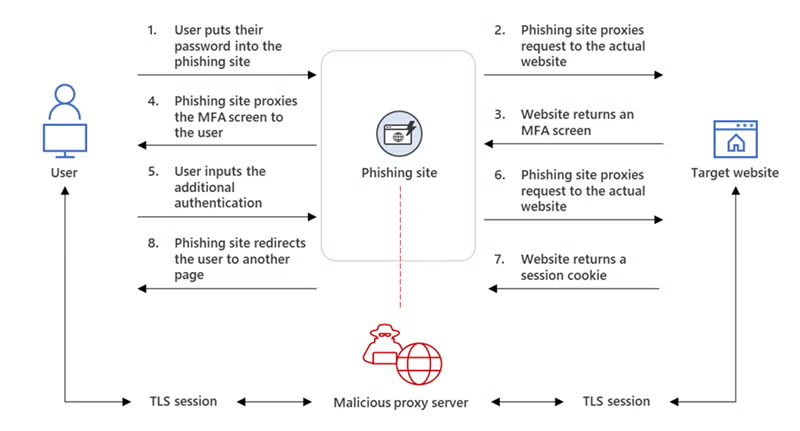
Why strong authentication does not stop modern breaches
Multi-Factor Authentication (MFA) and Zero Trust are often treated as the endgame of identity security.
If users authenticate strongly and every request is verified, the system should be secure.
In practice, many of today’s most damaging breaches happen after MFA succeeds.
This blog explains why MFA and Zero Trust fail against client-side attacks, and what actually needs to be protected.
The Critical Misconception About MFA
MFA answers only one question:
“Is this user allowed to log in?”
It does not answer:
- Is the browser environment safe?
- Is the session being observed?
- Is JavaScript execution trustworthy?
- Is the authenticated context being abused?
Once MFA is complete, the system assumes the session is legitimate.
Attackers exploit that assumption.
Authentication Is a One-Time Event
In modern web applications:
- MFA happens once
- A session or JWT is issued
- All subsequent requests rely on that token
From that point forward:
- The browser becomes the security boundary
- Tokens become the target
- Execution context matters more than credentials
This is where traditional models break.
The Client-Side Kill Chain (Post-MFA)
Step 1: User Authenticates Successfully
- MFA challenge is passed
- Token or session cookie is issued
- Backend considers the user trusted
No compromise yet.
Step 2: Malicious Code Executes in the Browser
This can happen via:
- Injected script
- Compromised third-party library
- Tag manager abuse
- Browser extension
The attacker does not need credentials.
Step 3: Token or Session Is Abused
The malicious code:
- Reads JWTs from memory or storage
- Hooks
fetch/XMLHttpRequest - Observes authenticated requests
- Replays or proxies actions
Every request is fully authenticated.
Step 4: Backend Sees “Normal” Traffic
From the server’s perspective:
- Valid MFA-backed session
- Correct user
- Correct permissions
- Correct IP
- Correct device
Zero Trust checks pass — because the user is trusted.
Why Zero Trust Does Not Save You Here
Zero Trust enforces:
- Identity verification
- Device posture
- Network controls
- Per-request authorization
It does not control:
- What runs inside the browser
- How JavaScript behaves
- Whether the session is being observed
- If authenticated actions are being driven by injected code
Zero Trust verifies who is calling.
Client-side attacks abuse how calls are made.
MFA Fatigue Is Not the Real Problem
Public discussion often focuses on:
- MFA fatigue
- Push bombing
- Social engineering
Those attacks aim to bypass login.
Client-side attacks do not need to bypass login at all.
They wait patiently for successful authentication — then act.
Why These Attacks Are So Hard to Detect
Client-side attacks:
- Generate valid traffic
- Use real users
- Respect rate limits
- Avoid obvious anomalies
- Look identical to legitimate behavior
Security tools tuned to detect unauthorized access see nothing wrong.
The attack lives entirely within authorized boundaries.
The Browser Is the Weakest Link in Zero Trust
Zero Trust architectures assume:
- Endpoints are measurable
- Identities are enforceable
- Requests are inspectable
Browsers break all three assumptions:
- JavaScript is dynamic
- Execution changes at runtime
- Third-party code runs with privilege
This creates a massive blind spot.
What Actually Protects Against Post-MFA Attacks
Stopping these attacks requires controls that operate after authentication:
- Visibility into browser-side execution
- Detection of unauthorized script changes
- Monitoring of DOM and runtime behavior
- Awareness of token exposure paths
Identity controls alone are insufficient.
How BreachFin Addresses the Post-Auth Gap
BreachFin focuses on the phase after MFA and Zero Trust complete.
BreachFin provides:
- Continuous monitoring of client-side execution
- Detection of script and behavior drift
- Early warning of browser-based compromise
- Evidence aligned with modern compliance needs
This enables detection before tokens are abused at scale.
Why This Matters for Real Security
Most organizations believe:
“If MFA is enabled, we’re safe.”
Reality:
- MFA protects login
- Zero Trust protects access
- Neither protects execution
Modern attacks target execution.
Final Takeaway
MFA and Zero Trust are necessary.
They are not sufficient.
Client-side attacks succeed because they:
- Do not break authentication
- Do not violate authorization
- Do not trigger backend controls
They exploit what happens after trust is granted.
If your security strategy stops at identity,
you are blind to how authenticated sessions are actually abused.
That is the layer BreachFin exists to protect.