Your Strongest Password Is Useless If It’s Stored in Plain Text
Organizations invest heavily in firewalls, endpoint protection, and identity management, yet one of the most common security weaknesses remains surprisingly simple: exposed secrets.
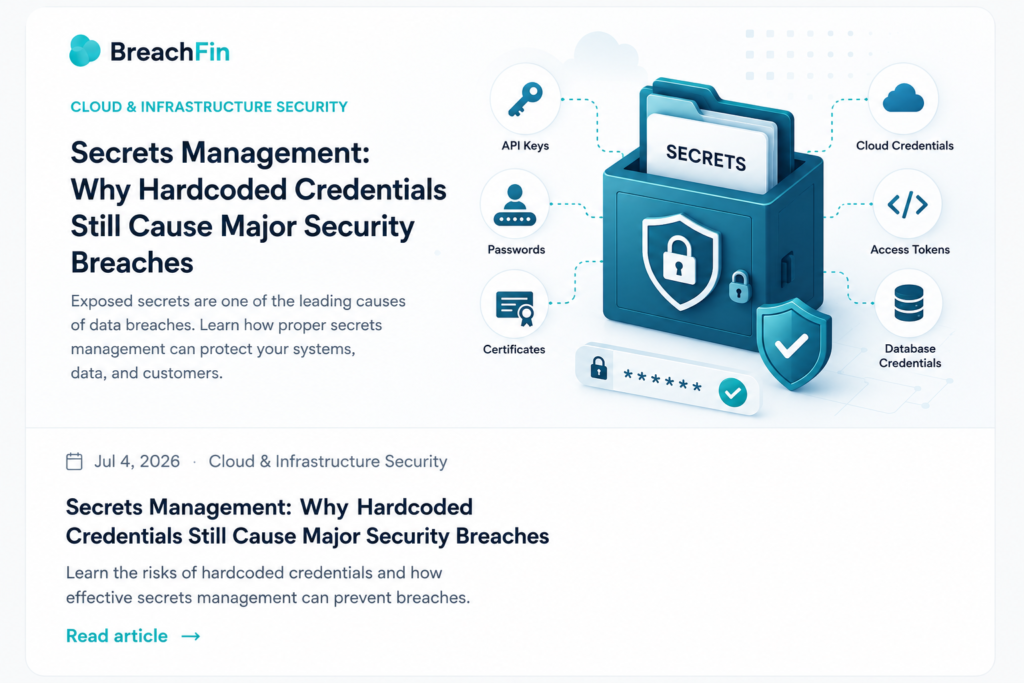
API keys, passwords, encryption keys, certificates, and access tokens are the digital credentials that allow applications to communicate securely. When these secrets are stored improperly, they become valuable targets for attackers.
Many high-profile cloud breaches have not occurred because attackers broke encryption—they happened because they found credentials that developers accidentally exposed.
Effective secrets management is no longer optional. It is a critical component of modern cybersecurity.
What Are Secrets?
In cybersecurity, a “secret” is any sensitive credential that grants access to systems, applications, or data.
Common examples include:
- API keys
- Database passwords
- Cloud access keys
- SSH private keys
- TLS certificates
- OAuth tokens
- Service account credentials
- Encryption keys
These secrets allow applications to authenticate and communicate securely without human intervention.
Why Hardcoded Credentials Are Dangerous
Developers sometimes store credentials directly inside:
- Source code
- Configuration files
- Scripts
- Git repositories
- Docker images
- CI/CD pipelines
Although convenient during development, hardcoded credentials create significant security risks.
If an attacker gains access to the codebase, they immediately gain access to the associated systems.
Even private repositories can eventually become exposed through accidental commits, compromised accounts, or insider threats.
Common Ways Secrets Become Exposed
Public Code Repositories
Developers occasionally push sensitive credentials to public repositories by mistake.
Attackers continuously scan platforms for exposed cloud keys and API tokens.
Some compromised credentials are discovered within minutes of being published.
Shared Configuration Files
Configuration files containing passwords are often copied between environments.
Without proper protection, these files may become accessible to unauthorized users.
CI/CD Pipelines
Automation pipelines require credentials to deploy applications.
Poorly secured pipelines can expose secrets through:
- Build logs
- Environment variables
- Shared runners
- Misconfigured permissions
Securing the software delivery process is just as important as securing production systems.
Over-Permissive Access
Sometimes credentials are not exposed—but they provide far more access than necessary.
If one credential becomes compromised, attackers may gain unrestricted access to cloud environments.
Least-privilege access significantly reduces this risk.
Best Practices for Secrets Management
Use a Dedicated Secrets Manager
Avoid storing credentials in application code.
Instead, use secure secrets management solutions that provide:
- Encryption
- Access controls
- Audit logging
- Automatic rotation
- Version management
Applications should retrieve secrets securely at runtime.
Rotate Credentials Regularly
Long-lived credentials increase risk.
Implement automatic rotation for:
- API keys
- Database passwords
- Service account credentials
- Certificates
Frequent rotation limits the usefulness of stolen credentials.
Apply Least Privilege
Each application should receive only the permissions required for its specific function.
Avoid using shared administrator credentials across multiple services.
Encrypt Secrets
Sensitive credentials should always be encrypted:
- At rest
- In transit
- During backup
Encryption adds another layer of protection even if storage systems are compromised.Monitor Credential Usage
Organizations should continuously monitor for:
- Unusual authentication attempts
- Geographic anomalies
- Unexpected API activity
- Privilege escalation
- Failed login patterns
Continuous monitoring helps identify compromised credentials before they can be abused.
Secrets Management in Cloud Environments
Cloud-native applications often rely on dozens of interconnected services.
Without centralized secrets management, organizations quickly lose visibility into:
- Who has access
- Which credentials are active
- Where secrets are stored
- When credentials expire
A centralized approach improves operational efficiency while reducing security risk.
Secrets Management and Compliance
Modern security frameworks emphasize protecting sensitive credentials.
Strong secrets management supports compliance with standards including:
- PCI DSS
- ISO 27001
- SOC 2
- NIST Cybersecurity Framework
- CIS Controls
Proper credential management also strengthens incident response and audit readiness.
Building a Strong Secrets Management Strategy
Organizations should establish a consistent process that includes:
- Centralized secret storage
- Automated credential rotation
- Least-privilege access
- Continuous monitoring
- Audit logging
- Secure software development practices
- Regular credential reviews
- Secure backup and recovery
Treating secrets as critical assets reduces both operational and security risks.
Final Thoughts
Cybersecurity is often viewed through the lens of advanced threats, but many successful attacks begin with something far simpler: exposed credentials. Hardcoded passwords, forgotten API keys, and poorly managed secrets continue to provide attackers with easy access to sensitive systems.
By adopting centralized secrets management, rotating credentials regularly, enforcing least-privilege access, and continuously monitoring authentication activity, organizations can significantly reduce the likelihood of credential-based attacks while improving compliance and operational resilience.
Strong security starts with protecting the keys that unlock your environment.