Cybercriminals Are No Longer Attacking Just You
Organizations spend millions protecting their own infrastructure, yet many overlook one of the fastest-growing attack vectors: their software supply chain.
Modern businesses rely on dozens—or even hundreds—of external vendors for software, cloud services, payment processing, analytics, customer support, and infrastructure. While these partnerships accelerate innovation, they also create new security dependencies.
If a trusted vendor is compromised, every organization connected to that vendor may also be at risk.
Recent high-profile supply chain attacks have demonstrated that attackers often prefer compromising one supplier instead of targeting thousands of organizations individually.
What Is a Supply Chain Attack?
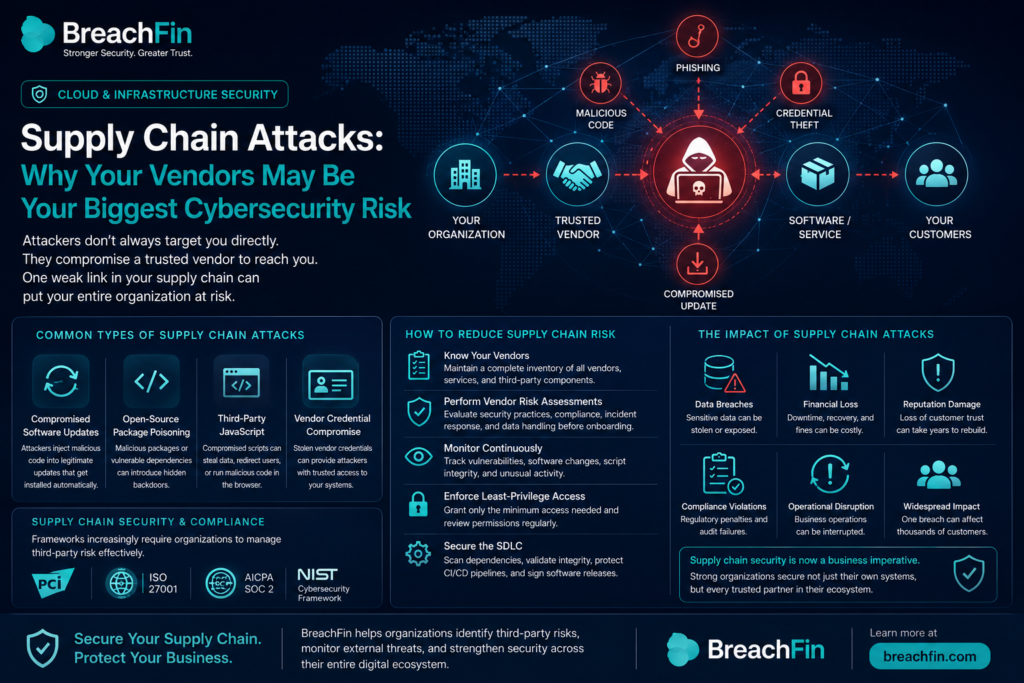
A supply chain attack occurs when attackers compromise a trusted third party to gain unauthorized access to customers, partners, or downstream systems.
Instead of attacking the target directly, attackers infiltrate software vendors, managed service providers (MSPs), cloud platforms, or open-source libraries that customers already trust.
Common targets include:
- Software vendors
- Cloud providers
- Open-source packages
- Third-party JavaScript libraries
- CI/CD pipelines
- Managed service providers
- Development tools
Because these systems are trusted, malicious updates often bypass traditional security controls.
Why Supply Chain Attacks Are Increasing
Today’s applications are built using components from multiple vendors.
A single web application may include:
- Open-source libraries
- Payment gateways
- CDN-hosted JavaScript
- Authentication providers
- Cloud APIs
- Analytics platforms
- Chat widgets
- Monitoring agents
Every integration expands the organization’s attack surface.
Attackers recognize that compromising one supplier can provide access to thousands of customers simultaneously.
Common Types of Supply Chain Attacks
Compromised Software Updates
Attackers inject malicious code into legitimate software updates.
Since organizations trust signed updates, malicious code may be installed automatically across thousands of systems.
Open-Source Package Poisoning
Developers frequently use open-source packages to accelerate development.
Attackers sometimes publish malicious packages or compromise existing ones to distribute malware through software dependencies.
Regular dependency reviews and software composition analysis (SCA) help reduce this risk.
Third-Party JavaScript Compromise
Modern websites depend on external JavaScript for analytics, payments, marketing, and customer engagement.
If one of these scripts is compromised, attackers can:
- Capture payment card data
- Steal customer credentials
- Inject malicious content
- Redirect users
- Execute browser-based attacks
Continuous client-side monitoring helps detect unauthorized script changes before they impact customers.
Vendor Credential Compromise
Attackers may steal credentials belonging to third-party vendors with privileged access.
If vendor accounts are not properly secured, attackers can gain access to sensitive systems without directly attacking the organization.
How Organizations Can Reduce Supply Chain Risk
Know Your Vendors
Maintain a complete inventory of:
- Software suppliers
- Cloud providers
- External APIs
- Third-party scripts
- Managed service providers
- Critical business applications
You cannot manage risks that you cannot identify.
Perform Vendor Risk Assessments
Before onboarding a vendor, evaluate:
- Security certifications
- Compliance programs
- Incident response capabilities
- Vulnerability management
- Data handling practices
- Access control policies
Security should be part of procurement—not an afterthought.
Monitor Third-Party Software Continuously
Do not assume software remains secure after deployment.
Continuously monitor:
- Software updates
- New vulnerabilities
- Dependency changes
- Script integrity
- Unexpected network connections
Continuous visibility enables faster response to emerging threats.
Enforce Least-Privilege Access
Third-party vendors should receive only the minimum access required.
Review vendor permissions regularly and remove unused accounts promptly.
Secure the Software Development Lifecycle
Organizations should:
- Scan dependencies for known vulnerabilities
- Validate software integrity
- Protect CI/CD pipelines
- Sign software releases
- Monitor build environments
Secure development practices reduce the likelihood of introducing compromised code into production.
Supply Chain Security and Compliance
Modern security frameworks increasingly emphasize third-party risk management.
Organizations pursuing standards such as:
- PCI DSS
- ISO 27001
- SOC 2
- NIST Cybersecurity Framework
are expected to understand and manage risks associated with vendors, suppliers, and external service providers.
Effective supply chain security is now a key component of regulatory compliance and operational resilience.
Building a Resilient Supply Chain Security Program
A mature strategy includes:
- Vendor inventory management
- Continuous vulnerability monitoring
- Software composition analysis
- Third-party risk assessments
- Client-side security monitoring
- Identity and access management
- Continuous security awareness
- Incident response planning
Security should extend beyond organizational boundaries to include every trusted partner.
Final Thoughts
Supply chain attacks demonstrate that an organization’s security is only as strong as the vendors and software it depends on. As businesses adopt more cloud services, open-source components, and third-party integrations, managing external risk has become a strategic necessity.
By maintaining visibility into suppliers, continuously monitoring software and dependencies, enforcing least-privilege access, and integrating vendor risk management into everyday operations, organizations can significantly reduce their exposure to one of today’s fastest-growing cybersecurity threats.