Every Website Depends on Third-Party Code
Modern websites rarely run on code written entirely by their own developers. Analytics platforms, chat widgets, payment processors, advertising networks, customer support tools, fraud detection services, and marketing platforms all rely on third-party JavaScript.
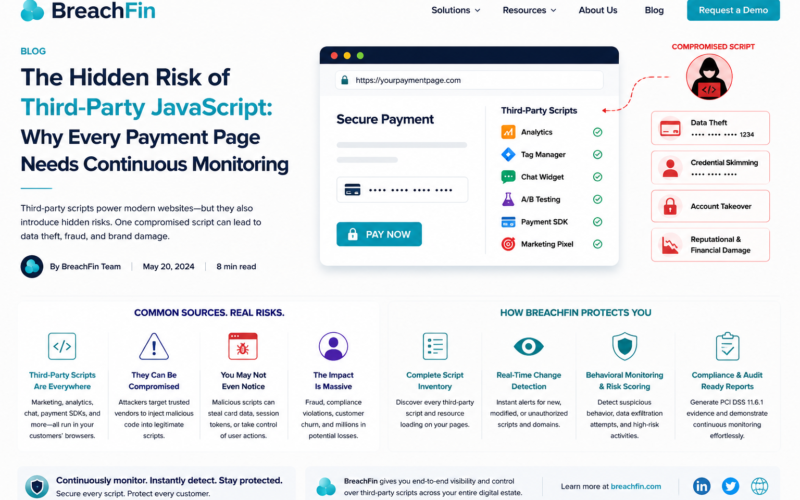
While these integrations improve functionality and user experience, they also introduce risk. Every external script loaded into a browser executes with the same privileges as your own website, making it a potential entry point for attackers.
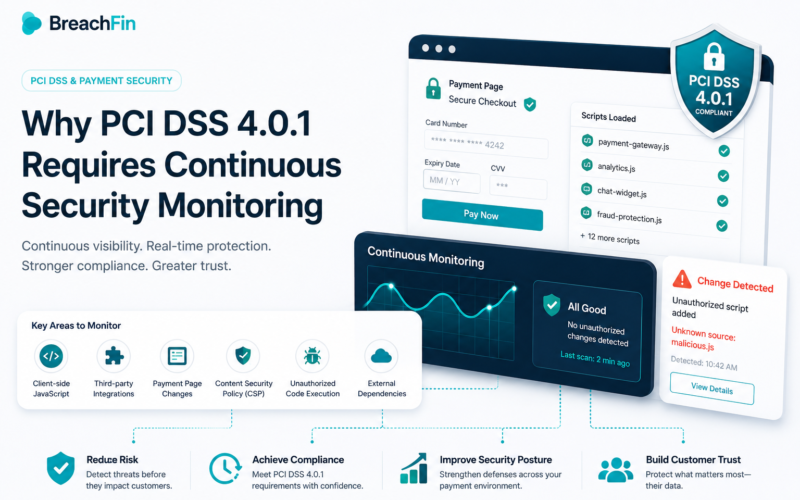
For organizations handling payment data, this risk has become so significant that PCI DSS 4.0.1 now requires organizations to actively monitor payment page scripts for unauthorized changes.
Why Third-Party Scripts Matter
A typical payment page may load JavaScript from several different vendors.
Examples include:
- Payment gateways
- Fraud prevention platforms
- Customer chat solutions
- Analytics tools
- Marketing tags
- Customer feedback widgets
- CDN-hosted libraries
Every additional script increases the attack surface.
If just one vendor is compromised, every website using that script may also become vulnerable.
How JavaScript Attacks Happen
Attackers don’t always target your infrastructure directly.
Instead, they look for trusted third-party providers that distribute JavaScript to thousands of websites.
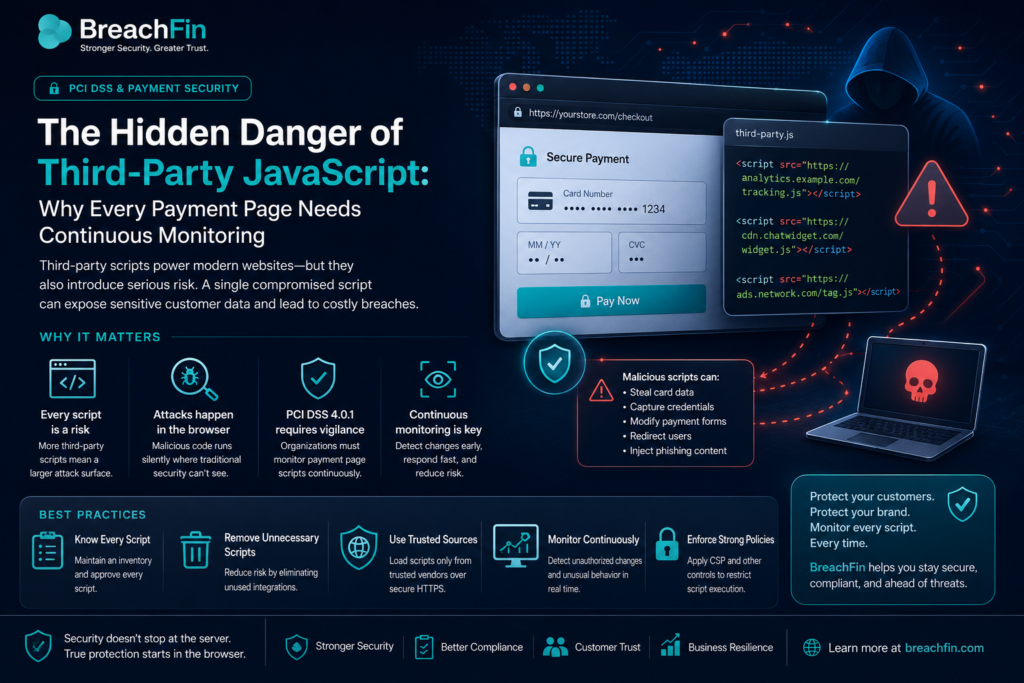
Once malicious code is injected, it can silently:
- Capture payment card information
- Steal login credentials
- Modify payment forms
- Redirect users
- Inject phishing content
- Send sensitive information to attacker-controlled servers
Because these attacks occur inside the customer’s browser, they often bypass traditional security controls.
Traditional Security Cannot See Browser Attacks
Many organizations invest heavily in:
- Firewalls
- Web Application Firewalls (WAF)
- Intrusion Detection Systems
- Endpoint Detection and Response (EDR)
- Network Monitoring
These controls remain essential but primarily protect servers and networks.
They cannot always detect malicious JavaScript executing within a customer’s browser after a webpage has loaded.
Browser-based attacks require browser-level visibility.
PCI DSS 4.0.1 Raises the Standard
PCI DSS 4.0.1 introduces stronger requirements for protecting payment pages.
Organizations are expected to:
- Maintain an inventory of payment page scripts
- Authorize every script
- Detect unauthorized modifications
- Monitor script integrity continuously
- Respond quickly to unexpected changes
This reflects a shift from periodic compliance to continuous security monitoring.
Best Practices for Managing Third-Party Scripts
Know Every Script Running on Your Website
Maintain an inventory that includes:
- Script source
- Business purpose
- Vendor
- Version
- Approval status
Unknown scripts should never appear on production payment pages.
Remove Unnecessary Scripts
Every unused library creates unnecessary risk.
Regularly review third-party integrations and remove those that no longer provide business value.
Use Trusted Sources
Load JavaScript only from trusted vendors using secure HTTPS connections.
Avoid downloading libraries from unverified repositories or unknown CDNs.
Monitor Script Integrity
Even trusted vendors can become compromised.
Continuous integrity monitoring helps detect:
- Unexpected code changes
- New external domains
- Unauthorized script additions
- Suspicious network requests
Early detection significantly reduces exposure.
Apply Strong Content Security Policies
Content Security Policy (CSP) restricts where scripts can load from and helps reduce the risk of malicious code execution.
Properly configured CSP also makes unauthorized script injection more difficult.
Why Continuous Monitoring Matters
Threats evolve every day.
Waiting for quarterly vulnerability scans or annual compliance assessments leaves organizations exposed for long periods.
Continuous monitoring allows security teams to:
- Detect changes immediately
- Investigate suspicious activity
- Validate authorized updates
- Reduce incident response times
- Demonstrate ongoing compliance
Security is most effective when organizations can identify issues before attackers exploit them.
A Business Issue, Not Just a Technical One
A compromised payment page can lead to:
- Stolen customer payment information
- Financial losses
- Regulatory penalties
- Brand damage
- Customer churn
- Incident response costs
Protecting client-side code is therefore essential for maintaining customer trust and business continuity.
Final Thoughts
Third-party JavaScript enables many of the features customers expect from modern websites, but it also expands the attack surface. As cyber threats continue to target the browser, organizations must extend their security programs beyond traditional infrastructure controls.
By maintaining visibility into every payment page script, authorizing third-party code, enforcing strong browser security policies, and continuously monitoring for unexpected changes, businesses can significantly reduce risk while meeting modern compliance expectations.