Every Modern Website Depends on Third-Party JavaScript
Today’s financial applications are built faster than ever.
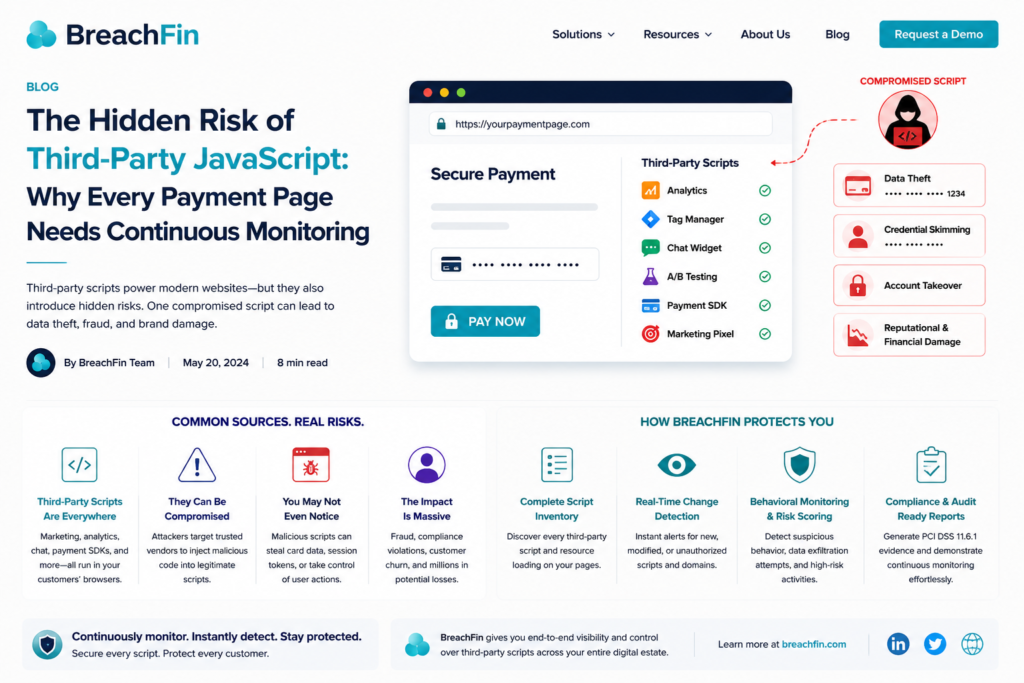
Whether it’s a bank, payment processor, fintech platform, or e-commerce website, nearly every application relies on third-party JavaScript to provide functionality such as:
- Analytics
- Payment gateways
- Customer support chat
- Marketing pixels
- Fraud detection
- User behavior tracking
- A/B testing
- Tag management
These services improve customer experience and accelerate development.
But they also introduce one of the largest—and often least monitored—attack surfaces in modern web applications.
Every third-party script executes with the same permissions as your own website.
If that script becomes compromised, so does your application.
The Growing Third-Party Supply Chain Risk
Organizations carefully secure their infrastructure, APIs, cloud environments, and applications.
However, they frequently overlook code delivered by external vendors.
A single webpage may load JavaScript from dozens of external domains.
Each additional dependency increases risk.
Unlike vulnerabilities in your own application, organizations often have little visibility into what third-party scripts are doing inside customer browsers.
This creates a blind spot that attackers increasingly exploit.
Why Attackers Target Third-Party Scripts
Cybercriminals understand that compromising one trusted vendor can affect thousands of websites simultaneously.
Rather than attacking individual companies, they target:
- Analytics providers
- Marketing platforms
- Customer support widgets
- Payment SDKs
- Advertising networks
- Tag managers
- Content delivery services
Once malicious JavaScript is injected into a trusted third-party service, every website loading that script may unknowingly deliver malicious code to visitors.
The Business Impact
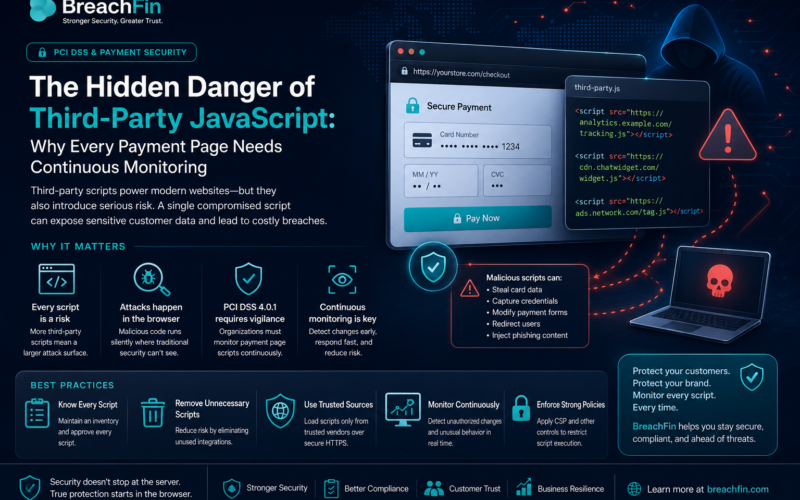
Compromised JavaScript can lead to:
Payment Card Theft
Attackers intercept payment information before it reaches legitimate payment processors.
Credential Theft
Login credentials can be silently collected and transmitted to attacker-controlled servers.
Session Hijacking
Malicious scripts may steal session tokens, allowing attackers to impersonate authenticated users.
Account Takeover
Compromised authentication data can provide unauthorized access to customer accounts.
Regulatory Violations
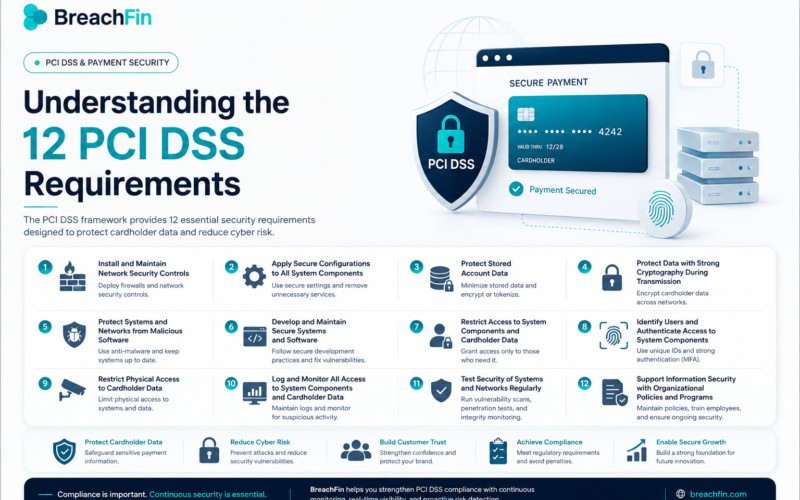
Sensitive customer information may be exposed, creating compliance challenges under PCI DSS, GDPR, and other regulatory frameworks.
Brand Damage
Customers expect secure digital experiences.
A client-side compromise can quickly erode trust and result in reputational harm.
Why Traditional Security Isn’t Enough
Most security programs focus on protecting:
- Firewalls
- Servers
- APIs
- Containers
- Cloud infrastructure
- Endpoints
However, these controls often have little visibility into what happens inside the customer’s browser.
Questions organizations struggle to answer include:
- Which third-party scripts are currently running?
- Has any JavaScript changed unexpectedly?
- Has a new external domain appeared?
- Are scripts behaving differently today than yesterday?
- Is customer data being sent to unauthorized destinations?
Without continuous monitoring, organizations may not detect malicious client-side activity until after customer data has been compromised.
The Rise of Client-Side Attacks
Client-side attacks continue to increase because browsers execute JavaScript automatically.
Attackers exploit this trust to:
- Modify checkout pages
- Capture payment details
- Inject malicious forms
- Redirect transactions
- Harvest authentication tokens
- Exfiltrate sensitive customer information
Since these attacks occur inside the browser, they frequently bypass traditional security controls.
How BreachFin Helps Protect Payment Pages
BreachFin provides continuous visibility into client-side activity, helping organizations detect suspicious behavior before attackers can impact customers.
Complete Third-Party Script Inventory
You cannot protect what you cannot see.
BreachFin continuously discovers and inventories every:
- JavaScript file
- Third-party dependency
- External resource
- Embedded widget
- Payment SDK
- Analytics script
Organizations gain complete visibility into every script executing on their websites.
Real-Time Change Detection
JavaScript changes constantly.
BreachFin continuously monitors:
- New scripts
- Modified scripts
- Deleted resources
- Unexpected domain changes
- Unauthorized code updates
Security teams receive immediate alerts when unexpected changes occur.
Script Integrity Monitoring
Trusted scripts should remain trustworthy.
BreachFin continuously validates script integrity by monitoring:
- Code changes
- Resource updates
- Domain reputation
- Loading behavior
- Third-party modifications
This helps identify supply chain attacks before they spread across customer sessions.
Behavioral Monitoring
Not every attack changes a file.
Some malicious scripts behave differently while appearing legitimate.
BreachFin analyzes:
- Network requests
- Browser behavior
- Data transmission patterns
- External connections
- Script execution activity
Behavioral monitoring provides an additional layer of protection beyond traditional integrity checks.
Compliance Visibility
Modern regulations increasingly recognize client-side threats.
BreachFin helps organizations strengthen compliance by providing visibility into:
- Third-party script inventory
- JavaScript changes
- Continuous monitoring evidence
- Security event history
- Audit-ready reporting
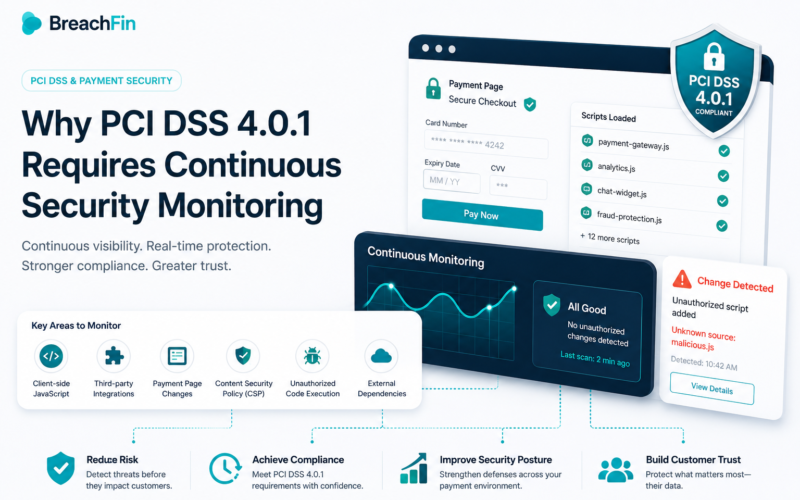
This supports organizations working toward PCI DSS 4.0.1 and other security frameworks that emphasize ongoing monitoring.
Why Continuous Monitoring Matters
Client-side attacks happen quickly.
A compromised third-party script can begin affecting customers within minutes.
Waiting for periodic vulnerability scans or annual penetration tests is no longer sufficient.
Continuous monitoring enables organizations to:
- Detect unauthorized JavaScript immediately
- Identify supply chain compromises
- Investigate suspicious browser activity
- Reduce customer exposure
- Improve incident response
- Protect brand reputation
The earlier malicious activity is detected, the lower the potential impact.
The BreachFin Advantage
BreachFin helps financial institutions, payment providers, fintech companies, and digital businesses strengthen client-side security through continuous monitoring.
Our platform provides visibility across:
- Third-party JavaScript
- Browser behavior
- Client-side changes
- API activity
- Cloud infrastructure
- Security events
Instead of discovering attacks after customer data has been compromised, organizations gain proactive intelligence that enables earlier detection and faster response.
Final Thoughts
Third-party JavaScript powers many of the features customers expect from modern digital experiences, but it also introduces one of the fastest-growing attack surfaces in cybersecurity.
Organizations can no longer assume that trusted third-party code will remain trustworthy forever.
Continuous visibility into scripts, browser behavior, and client-side activity is becoming essential for protecting customer data, maintaining compliance, and preserving brand trust.
At BreachFin, we believe client-side security should be continuous—not reactive. By monitoring every script, detecting unauthorized changes in real time, and providing actionable security insights, organizations can stay ahead of evolving browser-based threats before they impact customers.