The Payment Card Industry Data Security Standard (PCI DSS) provides a globally recognized framework for protecting cardholder data. Organizations that store, process, or transmit payment card information are expected to implement these security controls to reduce cyber risk and strengthen payment security.
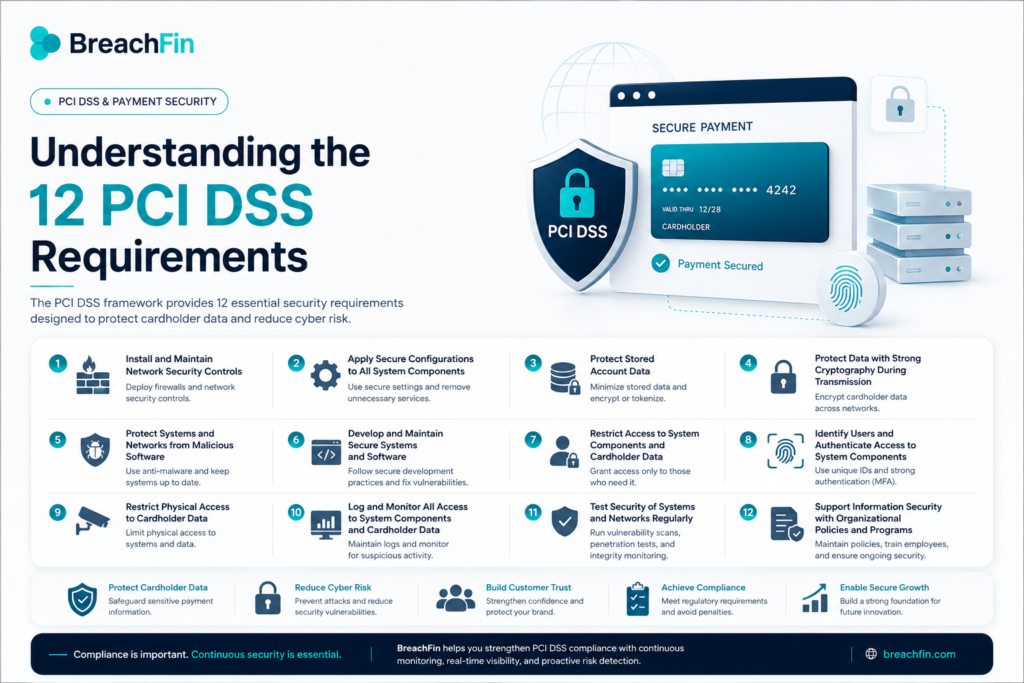
Below is an overview of the 12 PCI DSS requirements.
1. Install and Maintain Network Security Controls
Deploy firewalls and network security controls to protect cardholder data from unauthorized access and external threats.
2. Apply Secure Configurations to All System Components
Replace default passwords, disable unnecessary services, and maintain secure configurations across servers, applications, and network devices.
3. Protect Stored Account Data
Minimize stored cardholder data and use strong encryption or tokenization to protect sensitive information.
4. Protect Cardholder Data with Strong Cryptography During Transmission
Encrypt payment data whenever it is transmitted across public or untrusted networks.
5. Protect Systems and Networks from Malicious Software
Deploy anti-malware solutions, continuously monitor for threats, and keep security tools updated.
6. Develop and Maintain Secure Systems and Software
Follow secure software development practices, remediate vulnerabilities promptly, and maintain secure applications throughout their lifecycle.
7. Restrict Access to System Components and Cardholder Data
Grant users only the minimum level of access required to perform their job responsibilities.
8. Identify Users and Authenticate Access to System Components
Implement strong authentication mechanisms, including unique user IDs and multi-factor authentication (MFA).
9. Restrict Physical Access to Cardholder Data
Protect systems, servers, and storage locations from unauthorized physical access.
10. Log and Monitor All Access to System Components and Cardholder Data
Maintain detailed audit logs and continuously monitor systems to detect suspicious or unauthorized activity.
11. Test Security of Systems and Networks Regularly
Perform vulnerability scanning, penetration testing, file integrity monitoring, and other security assessments to validate defenses.
12. Support Information Security with Organizational Policies and Programs
Establish security policies, conduct employee awareness training, define incident response procedures, and maintain an ongoing security program.
How BreachFin Helps
BreachFin helps organizations strengthen PCI DSS readiness by providing visibility into client-side security, payment page integrity, cloud environments, and third-party integrations. Continuous monitoring enables security teams to detect changes early and improve their overall security posture.